ReviewsReview
5 min readNew
The first new web engine in years, written from scratch rather than borrowed from Google, Apple or Mozilla, reached a downloadable alpha on 23 November 2026. What it is, what early reviewers found, and who should try it.
Open almost any browser on almost any computer and the page you are reading is drawn by one of three engines. Chrome, Edge, Brave and Opera use Google's Blink. Safari uses Apple's WebKit. Firefox uses Mozilla's Gecko. Blink itself began as a fork of WebKit. The web is supposed to be an open platform built on public standards, yet in practice the question of how it behaves is settled by a very small number of codebases.
That is why a small alpha release on 23 November 2026 matters more than its version number suggests. Ladybird, a browser whose engine was written from scratch, is now something you can download and install, rather than something you had to compile yourself. We haven't tested it. This review is built from the project's own words and from two publications that did install it, all checked on 27 November 2026.
In his alpha announcement, project lead Andreas Kling puts it plainly: "The engine is our own, built from the ground up, and not a fork. The browser around it is modest, but functional." The project's FAQ says it uses no code from Blink, WebKit, Gecko "or any other browser engine", while using common third-party libraries for things like image, audio and video formats and encryption.
It is run by the Ladybird Browser Initiative, a US 501(c)(3) non-profit. The project says it takes no "default search deals", crypto tokens or other user monetisation, that sponsorships are unrestricted donations, and that sponsors have no say in its roadmap. Ars Technica noticed one result of that: the default search engine is set to "None".
The alpha is free, open source and a rolling channel with automatic updates. It runs on macOS and Linux. The Register lists macOS on Apple Silicon, plus Linux as a Flatpak and native Ubuntu and Fedora packages, and reports the macOS download at 68.4 MB. Windows is planned for later. Phones are not a current focus.
Both publications came away surprised, in a good way.
Ars Technica tested alpha version 2026.47.8 on a Linux mini PC and wrote that "the most surprising thing about the alpha build was how little it feels like alpha software." Its reviewer reports that Google Maps, GitHub, YouTube and news sites worked, that switching between a dozen tabs felt instant, and that content-blocking lists and autoplay blocking were available from the start. He could stall it, but only by repeatedly skipping around a 4K video stream with about ten tabs open.
The Register tested on Pop!_OS and reports it handled every site it tried, used about 6% of a Dell XPS 13's processor to play full-screen HD YouTube video, and showed no crashes in its short test.
Two short tests by two reviewers is not a verdict. Neither ran it for weeks, and both were browsing ordinary popular sites. But for an engine with no borrowed code, it is an encouraging start.
Here is the part to read twice. Kling's announcement says: "We want security nerds to hack it! A new browser gets hacked, over and over, and that's part of the process, so we make no promises about security today." He also warns that some websites won't work and it will crash sometimes.
A browser runs untrusted code from the entire internet. A mature engine has years of attacks and fixes behind it. Ladybird does not yet. That doesn't make it reckless to try, but it does decide what to try it with.
The project has tightened up in other ways. In June 2026 it stopped accepting public code contributions, saying AI tools have made it cheaper to produce work that looks like a serious contribution, and that a browser needs a smaller set of people responsible for what enters the code. You can read that as sensible security hygiene or as an unusual step for an open-source project. Both readings appear in the coverage.
Two more points come up in the reporting, and you should know them before you decide. The Register notes the project uses AI tools in development, including to help convert code to Rust, and argues it is "not some sloppy vibe-coded effort". Ars Technica added a note to its review pointing readers to criticism of Kling's public statements, and The Register places the project in what it calls the right-wing political wing of the free and open-source software movement. We are not going to adjudicate that here, but it is part of the picture, and for some people it will matter more than the code.
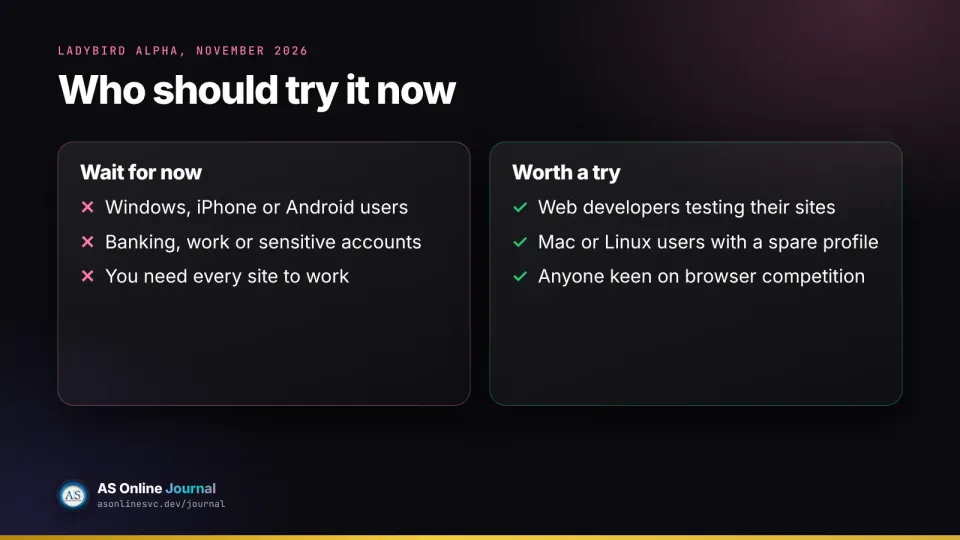
Worth a try if you:
Wait if you:
If you just want a different browser now, the established alternatives already use a different engine from Chrome: Firefox runs on Gecko and Safari on WebKit.
As a product, Ladybird is an alpha and should be treated like one. As an idea, it is the most exciting thing to happen to browsers in a long while. Every independent engine is another check on whether the web follows its published standards or simply follows whatever the dominant engine does, a point Ars Technica makes well. If it keeps improving at this pace, the web gets a little less dependent on a few companies. That is worth a download on a spare profile, even if it isn't worth your bank login yet.
This is a source-based review. Facts were checked against the sources listed below on 27 November 2026; we have not installed or tested Ladybird. There is no affiliate or sales link in this article.
Not yet, by the project's own account. Andreas Kling's alpha announcement says 'we make no promises about security today' and invites security researchers to try to break it. Use it for exploring and testing, not for banking, work accounts or anything sensitive.
Not at the moment. The alpha is for macOS (Apple Silicon, according to The Register) and Linux. The project's FAQ says Windows support is planned for a later stage and mobile platforms are not a current focus.
Nothing. It is free and open source, run by the Ladybird Browser Initiative, a US 501(c)(3) non-profit funded by donations and sponsorships. The project says it takes no default search deals and sponsors have no say in its roadmap.
No. This is a source-based review built from the project's own announcement and FAQ and from hands-on reports by Ars Technica and The Register, all checked on 27 November 2026. We have not installed or tested it.