
Careers in TechNews brief

3 min readNew

Entry-level engineering hiring has fallen faster than senior hiring in the US and, since early 2026, in the UK. The data does not prove AI is the cause. But if it is, the industry may be sawing off the bottom rung of its own ladder.
Every senior engineer you have ever worked with was, once, the person who got the boring tickets. The flaky test nobody wanted to fix. The small bug in the billing screen. The documentation update. It was dull, and it was also how they learned where the bodies were buried in a codebase, how to ask a good question, and what "done" really means.
Those are exactly the kinds of tasks people now hand to AI coding tools. So here is the uncomfortable question this essay is about: if companies stop hiring people to do the junior work because a model does it well enough, where will the next generation of senior engineers come from?
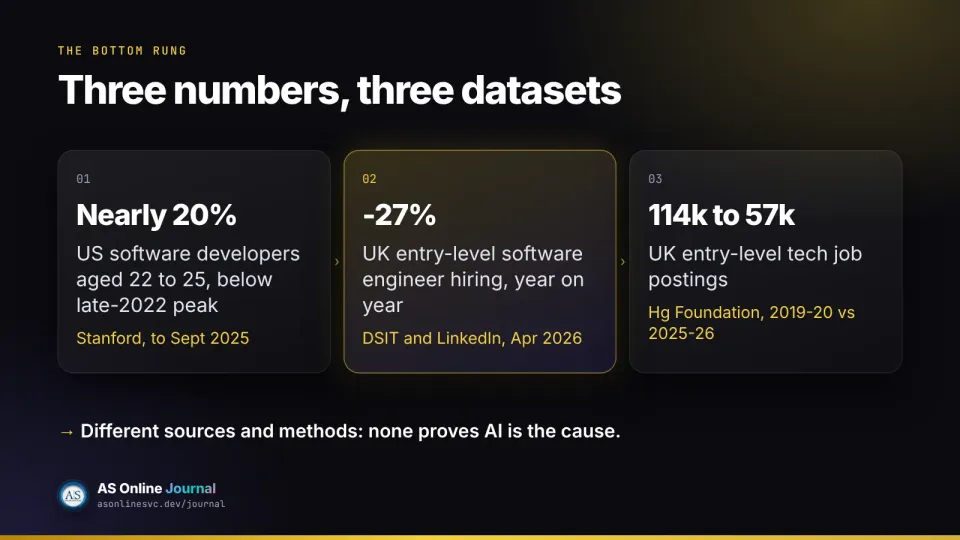
Start with the strongest evidence, which is American. In a paper first published in 2025 and updated on 13 November 2025, Stanford economists Erik Brynjolfsson, Bharat Chandar and Ruyu Chen used payroll records from ADP, the largest US payroll provider, covering millions of workers. Their findings are stark. By September 2025, employment for software developers aged 22 to 25 was "nearly 20%" below its late-2022 peak, while older age groups in the same jobs kept growing. Across the most AI-exposed occupations, workers aged 22 to 25 saw a 6% fall in employment from late 2022 to September 2025, against a 6 to 9% rise for older workers.
The UK picture is newer and more cautious. In June 2026 the Department for Science, Innovation and Technology published a snapshot of LinkedIn hiring data. In April 2026, entry-level hiring for Software Engineers was down 27% on a year earlier. In engineering as a function, entry-level hiring had fallen 19% against 10% for senior roles, a gap the paper says "only appeared in early 2026". And in October, the Hg Foundation, working from more than 70 million job postings, reported that advertised entry-level tech roles had roughly halved, from more than 114,000 in 2019 to 2020 to about 57,000 in 2025 to 2026, and had become a smaller share of tech hiring.
Here the honest essay has to slow down, because the counterargument is strong.
The UK government's snapshot says plainly that entry-level hiring "is falling broadly in line with the wider labour market rather than dropping rapidly on its own". The UK hiring rate turned negative in late 2022 as the post-pandemic hiring surge faded, and it was 14% down on a year earlier in April 2026, with every tracked industry in decline. The paper says some of the biggest falls are in roles where AI capabilities have grown, "but this is not yet causal evidence", and that those roles are seeing reduced hiring at all levels. It also notes employers are likely to favour more experienced candidates when they have plenty of applicants, which is what you would expect in any slow market.
Timing matters too. Late 2022 is when ChatGPT arrived, but it is also roughly when interest rates rose and tech companies began cutting after over-hiring during the pandemic. Any graph that bends in late 2022 has more than one suspect.
The Stanford authors know this. They tested for firm-level shocks, such as interest rate changes hitting some companies harder, and report that the declines for young workers in AI-exposed jobs remain after controlling for them. They also found something more hopeful: entry-level employment fell in occupations where AI mostly automates tasks, but grew where AI mostly augments the work. That is evidence consistent with AI playing a part, not proof that it is the main cause, and it is US evidence rather than British.
Our argument doesn't depend on settling the cause today. It depends on what happens if companies act on the belief that AI makes juniors unnecessary, whether or not the belief turns out to be right.
Engineering expertise is mostly built on the job. You become senior by making junior mistakes somewhere they can be caught. If a team replaces its two graduate hires with a coding assistant, it may ship just as much this year. But in five years it will have no mid-level engineers who grew up inside its systems, and in ten it will be hiring seniors from a market that every other company has also stopped training. Each firm's choice looks rational. Added together, they drain the pool everyone fishes from.
There is a second, quieter cost. The work handed to AI first is often the work that teaches judgement: reading someone else's code, tracing a bug, understanding why a test fails. A junior who only reviews AI output may become a fast editor without ever becoming a deep debugger. We don't know yet whether that matters as much as we fear. Nobody has watched a generation come up this way.
It would be easy to end on doom, and it would also be wrong. The same data has openings in it. The Hg Foundation found more than 5,600 entry-level tech postings that explicitly did not require a degree in 2025 to 2026, up 7% on the year before, and almost half of entry-level postings stating an education requirement didn't ask for one. Stanford's finding that augmentative uses of AI coincide with rising junior employment suggests the outcome isn't fixed by the technology. It depends on how companies choose to use it.
That is the real fork. A company can use AI to remove the junior role, or to make a junior useful faster, pairing a new engineer with tools that let them take on real work in month two rather than month twelve. The second path costs more this quarter and builds something the first path cannot buy later.
We don't yet know whether the UK engineering gap that opened in early 2026 will persist; the government paper says it "may close as conditions change". We don't know whether the US pattern will repeat here. We don't know what an engineer who learned with AI from day one will be good at that we were not.
What we do know is that ladders are only useful if they have a bottom rung. If you run a team, the most valuable hire you make next year might be the one the spreadsheet says you don't need.
Facts in this essay were checked against the sources listed below on 27 November 2026. The US and UK figures come from different datasets and methods and should not be compared directly.
Not proven. Stanford's study of US payroll data finds declines for 22 to 25-year-olds in AI-exposed jobs that remain after controlling for firm-level shocks, which is consistent with AI playing a part. The UK government's June 2026 snapshot of LinkedIn data says some of the biggest declines are in roles where AI capabilities have grown, but that this is not yet causal evidence, and that entry-level hiring is broadly tracking a weak market.
The Hg Foundation's October 2026 briefing, based on Lightcast job postings, says employers advertised more than 114,000 entry-level tech roles in 2019 to 2020 and around 57,000 in 2025 to 2026. The government's LinkedIn snapshot found entry-level Software Engineer hiring down 27% year on year in April 2026.
Yes, though fewer than before 2020. The Hg Foundation says more than 5,600 entry-level tech postings explicitly did not require a degree in 2025 to 2026, 7% more than the year before, and that almost half of entry-level postings that state an education requirement do not ask for a degree.
careers software-engineering ai-and-work entry-level-jobs essay