Careers in TechExplained

5 min readNew

Most developers now use AI tools, and many don't trust them. What the latest survey data confirms, what is plausible for the next few years, and the claims to treat with care.
The developer job is changing, not disappearing, on the evidence we have. Most developers now use AI tools, and half of professionals use them every day. But trust is low, and the skills that matter most are shifting towards checking, designing and owning the result. Anyone who tells you exactly how many developer jobs will exist in five years is guessing.
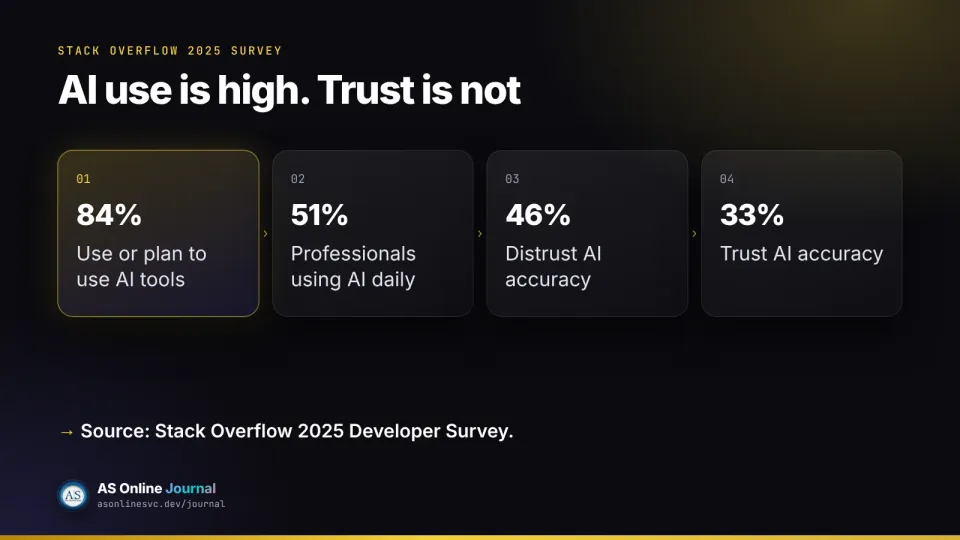
Stack Overflow's 2025 Developer Survey found that 84% of respondents were using or planning to use AI tools in their development process, up from 76% the year before. 51% of professional developers used AI tools daily.
The same survey found that more developers actively distrust the accuracy of AI tools (46%) than trust it (33%), and only 3% "highly trust" the output. Experienced developers were the most cautious, with the highest "highly distrust" rate at 20%. Stack Overflow's own reading is that this indicates "a widespread need for human verification for those in roles with accountability".
Major open-source projects are writing policies. The GNU Compiler Collection's AI policy, for example, says that "for the time being" GCC will decline legally significant contributions that include LLM-generated content, with limited exceptions such as test cases. Contributions with LLM-generated content must carry an "Assisted-by:" tag, and everything must be submitted "by a human who understands the changes and is prepared to answer questions about them".
| Do not assume | Why |
|---|---|
| "AI will replace most developers soon" | Survey data shows heavy use but low trust; it does not measure job losses |
| "Nothing will change" | Daily use by half of professionals is already a big change in how work is done |
| Survey figures describe everyone | Survey respondents are self-selected and skew towards people engaged with the community |
| Today's tools set the limit | Capabilities change quickly, in both directions of hype |
The data points one way: AI is now part of everyday development, and humans remain responsible for what ships. That makes judgement, testing and clear understanding more valuable, not less. Anything beyond that is a forecast, and forecasts in this area have a poor track record.
Stack Overflow's 2025 Developer Survey found 84% of respondents were using or planning to use AI tools in their development process, up from 76% the year before, and 51% of professional developers used them daily.
Not very much. The same survey found more developers actively distrust the accuracy of AI tools (46%) than trust it (33%), and only 3% report highly trusting the output.
There is no reliable evidence to say so. What the data shows is a change in how developers work, with human checking still central. Be wary of confident predictions either way.