News & ExplainersExplained
6 min readNew
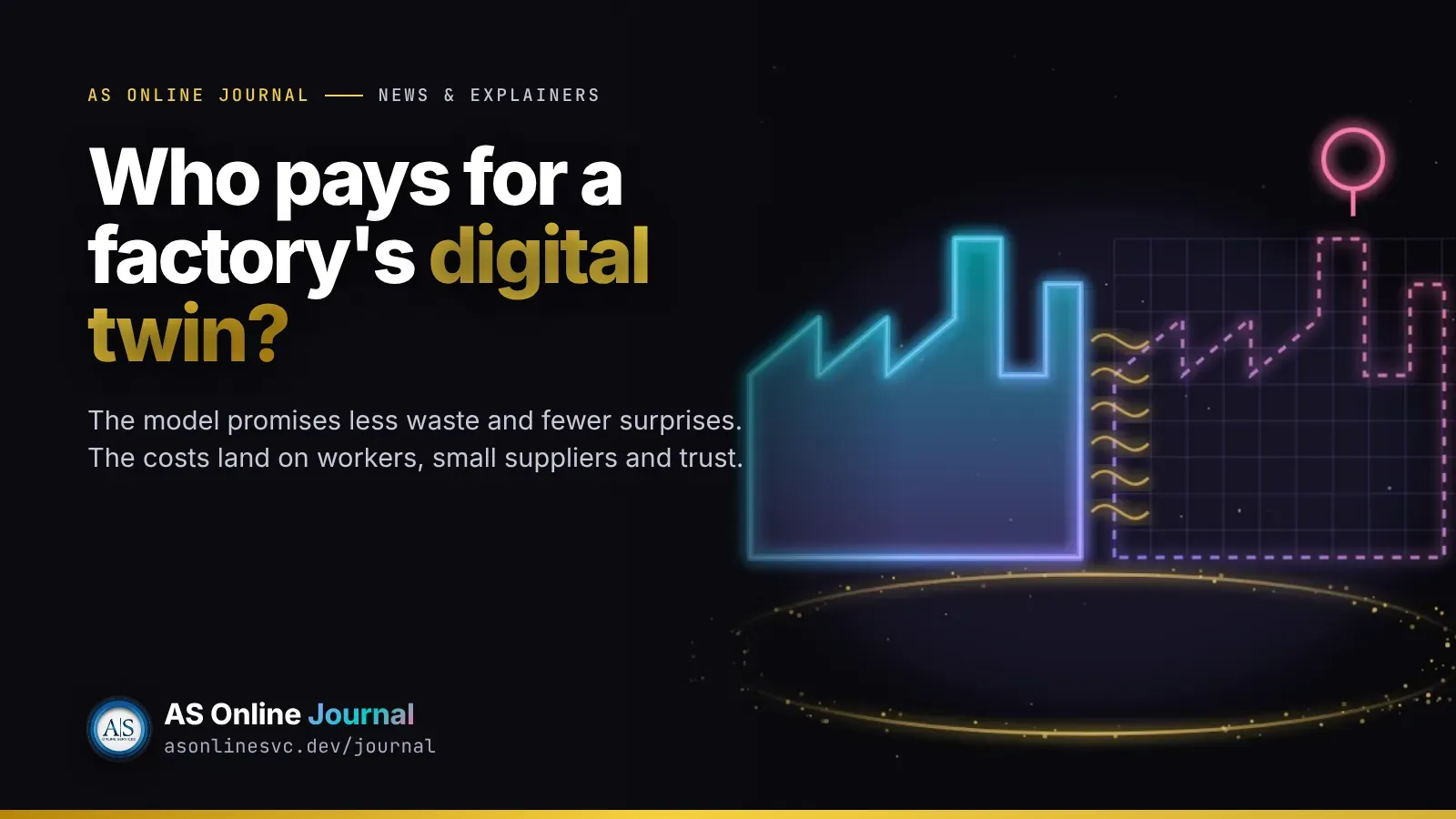
Digital twins promise less waste and fewer surprises on the factory floor. The costs are real too, and they do not fall evenly.
A digital twin is a living model of something real. In manufacturing, NIST describes twins as "synchronized virtual models that help manufacturers represent, diagnose, predict, and optimize their operations", and says they can help increase production, improve quality and reduce costs. There is even an international standard, ISO 23247, that sets out a framework for digital twins in manufacturing.
The appeal is easy to see. Test a new line layout on the model before moving a single machine. Spot a bearing wearing out before it fails. Try a change to a recipe without wasting a batch. Those are real goods: less waste, fewer accidents, fewer unpleasant surprises.
This essay is about the other side of the ledger. Not whether twins are good or bad, but who quietly pays for them.
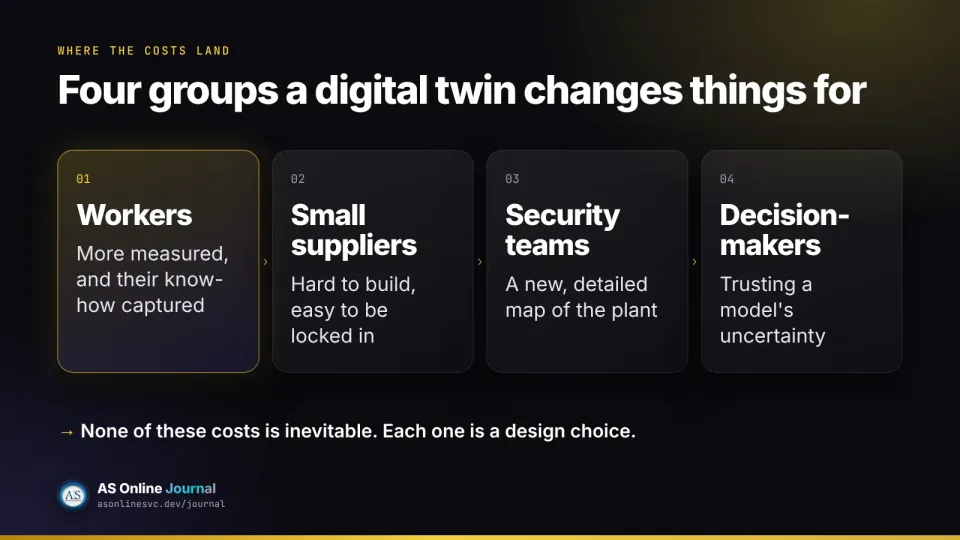
A twin is only as good as the data feeding it, and on a factory floor much of that data is about people: who ran which machine, how long a changeover took, where someone walked, when they paused. Even when the aim is the process, the people inside it are measured more finely than before.
That brings two costs. The first is surveillance creep. Data gathered to tune a machine can be reused to rate a person. In the UK, if the data relates to identifiable workers, data protection law applies, and the ICO publishes guidance on monitoring workers that sets out what employers must and should do. The ICO notes that the guidance is under review after the Data (Use and Access) Act, which is itself a sign that the rules are still settling.
The second cost is subtler: know-how capture. Experienced operators carry tacit knowledge, the sound a machine makes before it jams, the batch that needs an extra minute. A good twin tries to encode exactly that. Once it is in the model, the knowledge belongs to the company, and the person who taught it may find their bargaining position weaker. Nobody signs a contract for that transfer.
NIST's own programme page is candid: building digital twins correctly is challenging, "especially for small and medium-sized enterprises", and a major barrier is the lack of standards for vocabulary, design, interoperability, trustworthiness and validation.
That creates an uneven field. Large manufacturers can afford specialist teams and custom platforms. Smaller suppliers face a choice between falling behind, or buying a packaged platform whose data formats they do not control. When a large customer asks suppliers to plug into its twin, the cost of compliance can fall on the businesses least able to bear it, and the data they share may be worth more to the customer than to them.
A twin is, by design, a detailed and current picture of how a plant works. NIST's report on security and trust considerations for digital twins discusses both traditional and novel cybersecurity challenges the technology brings. Put simply: the model that helps engineers plan a change could help an attacker plan one too. Protecting it is a new, ongoing cost, usually borne by security teams who were not in the room when the twin was bought.
Models are confident in a way people are not. A dashboard that says a line will run at a certain rate looks authoritative, even if it rests on assumptions. NIST's work stresses models "that can be validated with quantified uncertainty", which is exactly the part that tends to disappear on the way from an engineer's notebook to a manager's screen.
When a supervisor's experience disagrees with the twin, who wins? If the answer is always the model, a workplace has quietly moved authority from people who can be questioned to a system that cannot.
All of this can be read as a case against twins. It should not be.
Twins can make work safer: testing a risky change on a model instead of on a live line protects the people who would otherwise absorb the risk. They can reduce waste and energy use. And capturing know-how is not only a loss: it can preserve skills when experienced staff retire and help new starters learn faster. For small manufacturers, shared standards could eventually make twins cheaper, not just a big-company advantage.
The fair conclusion is that the costs are real but not inevitable. Each one is a design choice.
A useful test comes from the UK's Gemini Principles, written for digital twins of the built environment: every twin must have a clear purpose, must be trustworthy and must function effectively. Applied to a factory, that suggests some plain questions:
We do not yet know how the benefits and costs of twins will settle across a whole industry. Standards are still developing, UK monitoring guidance is under review, and most of the evidence comes from the organisations building them. That uncertainty is a reason to design carefully now, while the choices are still open.
Sources checked on 24 November 2026. This is an essay, not legal or employment advice.
NIST describes digital twins as synchronised virtual models that help manufacturers represent, diagnose, predict and optimise their operations. A twin is fed with data from the real machines or processes it mirrors, so it can be used to test changes or spot problems before they happen on the floor.
If the data identifies or relates to individual workers, UK data protection law applies. The ICO publishes guidance for employers on monitoring workers, and says that guidance is under review following the Data (Use and Access) Act. This article is not legal advice.
No, but NIST notes that building them correctly is challenging, especially for small and medium-sized enterprises, partly because common standards are still developing. That is one reason the benefits can be uneven.