News & ExplainersExplained

6 min readNew

The UK still has no legal right to switch off. The real failures are in how messages, notifications and on-call duties are designed, and those can be fixed.
Most out-of-hours messages are not sent by people who expect an instant reply. They are sent because it is convenient for the sender, and they land as if they were urgent because of how our tools work. In the UK there is still no legal right to switch off, so for now this is a design problem, not a legal one. Teams that write down what counts as urgent, how it reaches someone, and what can wait until morning fix most of it without new software.
UK. There is no explicit right to disconnect in UK law. It is not in the Employment Rights Act 2025, and the government's implementation timeline, updated on 5 November 2026, does not list it. The government has said it would pursue it through a statutory code of practice, and law firm Lewis Silkin notes that a draft is still awaited.
What does apply is working time law. GOV.UK says you cannot work more than 48 hours a week on average, normally averaged over 17 weeks, unless you opt out, and most workers have the right to 11 hours' rest between working days. Finish at 8pm, and you should not start again until 7am.
Ireland offers a useful model. Its Workplace Relations Commission Code of Practice describes three elements: the right not to routinely work outside normal hours, the right not to be penalised for refusing to attend to work matters outside those hours, and a duty to respect other people's right to disconnect. Breaking the code is not an offence, but courts and the WRC must take it into account in related cases.
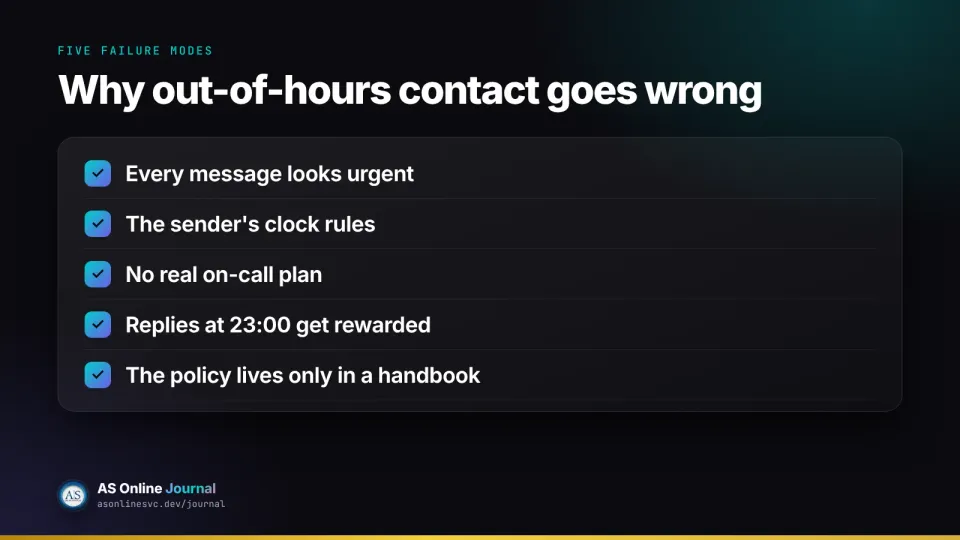
A message about next quarter's budget and a message saying the website is down arrive the same way: one ping, one badge, one buzz. The receiver cannot tell which is which without opening it, and once it is open, work has started. The failure is not the message. It is that the channel carries no signal about urgency.
Sending is cheap and the sender's moment feels like the right one. If you write the email at 22:00 because that is when you have time, it arrives at 22:00. Across time zones the problem multiplies: a 09:00 message in Bengaluru arrives in London at 03:30 in winter.
When nobody is formally responsible out of hours, everybody is, informally. The most conscientious person, or the most junior, ends up answering. Real emergencies get handled by whoever happens to look at their phone, which is unfair and unreliable at the same time.
If the person who answers at 23:00 is the one who is praised, the norm is set, whatever the policy says. People copy what is noticed, not what is written.
A paragraph in a staff handbook that says "we respect your time" changes nothing if the tools, rotas and habits stay the same.
Each failure has a design fix, and most need only the tools you already have.
| Failure | Design fix |
|---|---|
| Everything looks urgent | Agree one channel that means "urgent", such as a phone call, and keep everyday chat and email out of it |
| The sender's clock rules | Use scheduled send. Outlook and Gmail can both delay a message until working hours |
| No on-call plan | If out-of-hours cover is genuinely needed, make it a named, rotated, recognised duty, with a clear definition of what triggers a call |
| Replies are rewarded | Managers go first: no evening replies to non-urgent messages, and say so out loud |
| Policy in a handbook | Put the rules where work happens: notification schedules, status messages and the team channel's pinned note |
Notification schedules help on the receiving side. Slack, for example, lets you set a notification schedule for routine times you prefer not to be interrupted. These are useful, but they shift the burden onto the receiver. The bigger gains come from senders and managers changing habits.
Five lines, agreed together and pinned where the team works:
Some roles genuinely need out-of-hours cover: hospitals, infrastructure, customer support across time zones. The goal is not zero contact. It is contact that is planned, fair and rare. Watch for two traps: an "urgent" channel that slowly fills with non-urgent messages, and a rota that exists on paper while the same two people still get every call. Both are worth checking at each review.
Not at the time of writing (23 November 2026). It is not in the Employment Rights Act 2025, and it does not appear in the government's implementation timeline updated on 5 November 2026. The government previously said it would pursue it through a statutory code of practice, but none has been published.
The Working Time Regulations. GOV.UK says workers cannot work more than 48 hours a week on average unless they opt out, and have the right to 11 hours' rest between working days. Required out-of-hours work counts towards these limits.
Ireland has a Workplace Relations Commission Code of Practice on the right to disconnect. Breaking a code is not an offence in itself, but courts, the Labour Court and the WRC must take a relevant code into account in proceedings.