Skip to content
AS OnlineIndependent by design.
Menu
Let’s talk
Skip to content
AS Online Journal cover: Let's Go, build a real Go web app, with a glowing glass book opening into a stack of connected translucent building blocks on a dark background.
Reviews
Review4 min readNew
4 sources to explore ↗

Let's Go review: should a beginner pay for Alex Edwards' Go web development book?

A 416-page, build-as-you-read guide to making a complete web application in Go. What it covers, what you need to know first, which package to pick, and the free alternatives.

This article contains an affiliate link: if you buy through it, AS Online earns a 10% commission at no extra cost to you.

In short

Let's Go is a book for people who know a little Go, or another programming language, and want to get from "I can write a function" to "I can build and ship a proper web application". It walks you through one complete project, from setting up the workspace to sessions, logins, security and testing. Buyers rate it extremely highly. It is not a first programming book, and the free official material is the right place to start if you are brand new. This is a research-only review: we have not worked through the book ourselves.

What you get

According to the product page, checked on 23 November 2026:

  • 416 pages (in PDF), in HTML, PDF and EPUB formats;
  • written for Go 1.27, last updated 26 August 2026;
  • two packages: the Book at $34.95, or the Professional Package at $59.95, which adds the full source code for each chapter, printable cheat sheets for Go's net/http and database/sql packages, and guided exercises to check your understanding.
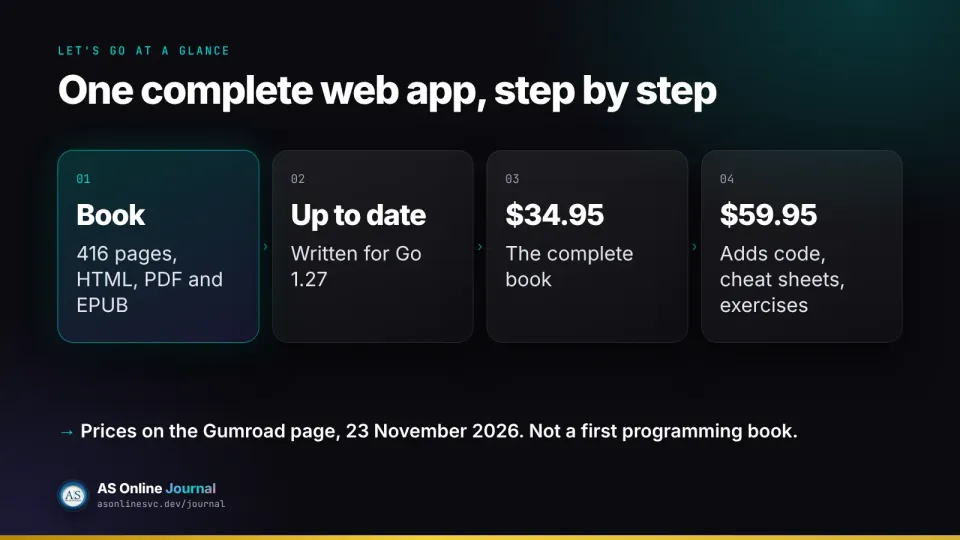
Let's Go at a glance: one complete web application built step by step, 416 pages, written for Go 1.27, in two packages at $34.95 and $59.95.

What it teaches

The book's approach is to learn by building. The chapter list runs in the order you would build a real app:

  1. Foundations: starting a server, handlers, routing (including wildcard and method-based routes), project structure, HTML templates and static files.
  2. Configuration and errors: command-line settings, structured logging, dependency injection and centralised error handling.
  3. Databases: setting up MySQL, connection pools, designing a model, queries and transactions.
  4. Dynamic templates and middleware: caching templates, custom functions, request logging and recovering from panics.
  5. Forms and sessions: parsing and validating forms, showing errors, and keeping users signed in.
  6. Security and testing: HTTPS, preventing SQL injection, CSRF, XSS and clickjacking, password hashing, sign-up and login, request context, and unit, integration and end-to-end tests.

That last group is what sets a book like this apart from scattered blog posts. Security and testing are where self-taught projects usually fall down, and here they are part of the main build rather than an afterthought.

The ratings

The Gumroad page showed 5.0 out of 5 from 249 ratings, with 96% five stars. The page quotes readers describing it as the best book they have read on building a non-trivial Go web app. As with any seller page, these are buyers' ratings, so they show satisfaction rather than a comparison with other books.

Try these free resources first

Go has unusually good free learning material. Before you pay, try:

  • A Tour of Go, the official interactive introduction. If it feels too hard, you are not ready for this book yet.
  • Go by Example, short annotated examples of each language feature.
  • The official Go documentation, including the "Writing Web Applications" tutorial, which builds a tiny wiki.
  • The book's free sample, linked from the product page, so you can see whether the writing style suits you.

If you finish the Tour and the wiki tutorial and want to build something much bigger with a guide beside you, that is the moment this book is aimed at.

Who it suits

  • Developers coming from another language, such as Python, PHP or JavaScript, who want to build web apps in Go properly.
  • Go learners who have done the basics and now want to see how a whole application fits together.
  • Self-taught developers who want security and testing covered in the same flow as the features.

Who should skip it

  • Complete beginners to programming. Start with the free material above.
  • People who want an API-only or JSON service guide. This book builds a server-rendered web application with HTML templates. The author sells a separate follow-up on APIs, which we have not reviewed here.
  • Anyone who wants video. This is a written book.

Our verdict

For someone at the right stage, a single, well-reviewed, up-to-date book that takes you through a full web application, security and tests included, is good value at $34.95. Do the free Tour of Go first, read the free sample, and buy it when you are ready to build.

If it suits you, you can get Let's Go on Gumroad. Check the current price and package before you pay.

Frequently asked questions

How much does Let's Go cost?

On 23 November 2026 the Gumroad page listed the book at $34.95 and the Professional Package at $59.95, in US dollars. Your bank converts the price, and tax may be added at checkout.

Is Let's Go for complete beginners to programming?

Not really. It is aimed at people who know the basics of Go, or of another language, and want to build a real web application. If you have never programmed, start with the free Tour of Go first.

Which version of Go does it cover?

The product page says it is written for Go 1.27 and was last updated on 26 August 2026.

Did AS Online read the whole book?

No. This review is based on the public product page, its chapter list and ratings, checked on 23 November 2026. The author offers a free sample so you can judge the writing yourself.
Sources checked

go golang web-development books review

Related articles