AI ToolsExplained

3 min readNew
"A human reviews it" is the most common safeguard for AI at work, and the easiest to hollow out. How human checks fail, the UK cases that show it, and how to design checks that actually catch mistakes.
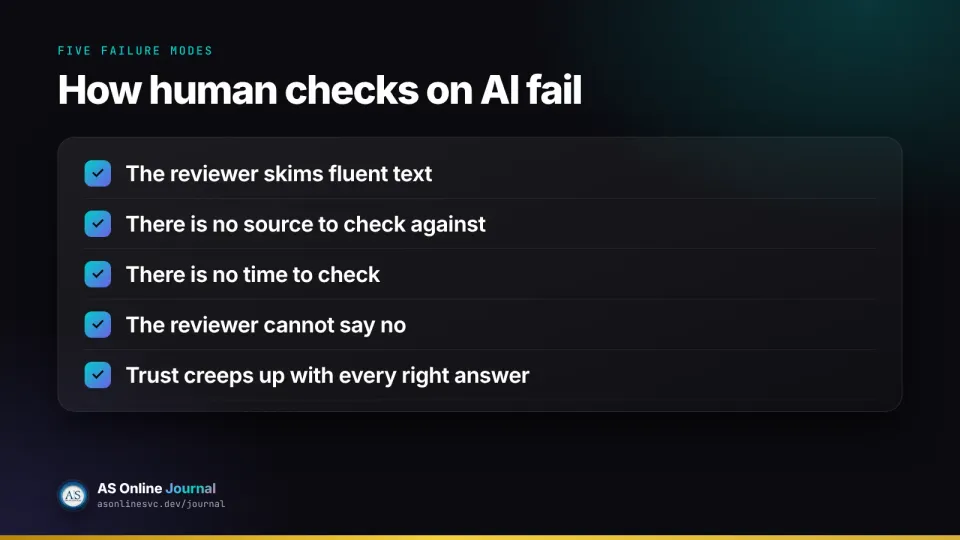
"A human checks everything before it goes out" is how most teams make AI feel safe. It is a good rule that fails quietly. People skim fluent text, trust the tool more each time it is right, and stop checking when they are busy. A June 2025 High Court judgment on fake legal citations shows the cost. The fix is not to ban the tools but to design the check: say what must be verified, against what source, by someone with the time and authority to say no.
In Ayinde v London Borough of Haringey, handed down on 6 June 2025, the Divisional Court dealt with two cases where lawyers had put false material before the court. In one, the grounds of a claim cited five cases that did not exist. The judgment says tools like ChatGPT "are not capable of conducting reliable legal research": their answers "may make confident assertions that are simply untrue" and "may cite sources that do not exist".
The key line for every workplace is the duty it sets out. People who use AI for research "have a professional duty therefore to check the accuracy of such research by reference to authoritative sources" before relying on it. The court added that this is no different from relying on a trainee's work or an internet search.
AI is new, but over-trusting a computer is not. The Post Office Horizon IT Inquiry is examining how hundreds of sub-postmasters were prosecuted on the basis of data from the Horizon accounting system, which was later shown to have bugs. The details are for the Inquiry, but the broad lesson is widely drawn: when an organisation assumes the system is right, the people questioning it carry the burden of proof.
| Instead of | Try |
|---|---|
| "Someone reads it before it goes out" | "Every name, number, quote and citation is checked against its source" |
| Reviewing the whole document | A short checklist of the claims that would cause harm if wrong |
| Checking against memory | Checking against the original document, database or policy |
| The author checking their own AI draft | A second person, for anything external or high-stakes |
| An unspoken expectation to approve | A clear right to reject, with no blame for slowing things down |
| Assuming the check happens | Recording who checked what, and spot-checking the checks |
The UK government's AI Playbook for civil servants takes a similar line, with principles that include knowing the limits of AI tools and keeping meaningful human control at the right stages.
If an AI error has already gone out:
AI tools can save real time, and nobody needs to pretend otherwise. But the saving is only real if checking is part of the job, not an optional extra at the end. The courts have now said plainly that "a computer gave me this" is no defence. That standard is worth adopting before something goes wrong.
In Ayinde v London Borough of Haringey [2025] EWHC 1383 (Admin), handed down on 6 June 2025, the Divisional Court said tools like ChatGPT are not capable of conducting reliable legal research, and that lawyers who use AI have a professional duty to check its output against authoritative sources before relying on it.
Only if the reviewer has the time, the knowledge and the source material to check it, and is genuinely free to reject it. A quick glance at fluent text is not a check.
The tendency to trust an automated system's output over other evidence, or to stop looking for errors because a computer produced the answer.