AI ToolsExplained
4 min readNew
AlphaFold won a Nobel Prize and made 200 million protein predictions freely available. Behind the breakthrough sit decades of public data, unequal access to computing, and questions about who controls the tools.
AI has already changed parts of science. The clearest example is protein structure prediction, recognised with the 2024 Nobel Prize in Chemistry. Its benefits are real and, in that case, widely shared: hundreds of millions of predictions are free to use. But the breakthrough rests on decades of painstaking public work, the newest tools need computing power many labs do not have, and companies increasingly set the terms of access. The costs are less visible than the headlines, and they are not shared evenly.
On 9 October 2024, the Royal Swedish Academy of Sciences awarded half the Nobel Prize in Chemistry to David Baker for computational protein design, and half jointly to Demis Hassabis and John Jumper of Google DeepMind for protein structure prediction. The Academy said that with AlphaFold2, presented in 2020, they had been able to predict the structure of "virtually all the 200 million proteins that researchers have identified", and that it had been used by "more than two million people from 190 countries".
The AlphaFold Protein Structure Database, a partnership between Google DeepMind and EMBL's European Bioinformatics Institute, makes those predictions "freely available to the scientific community", with over 200 million entries.
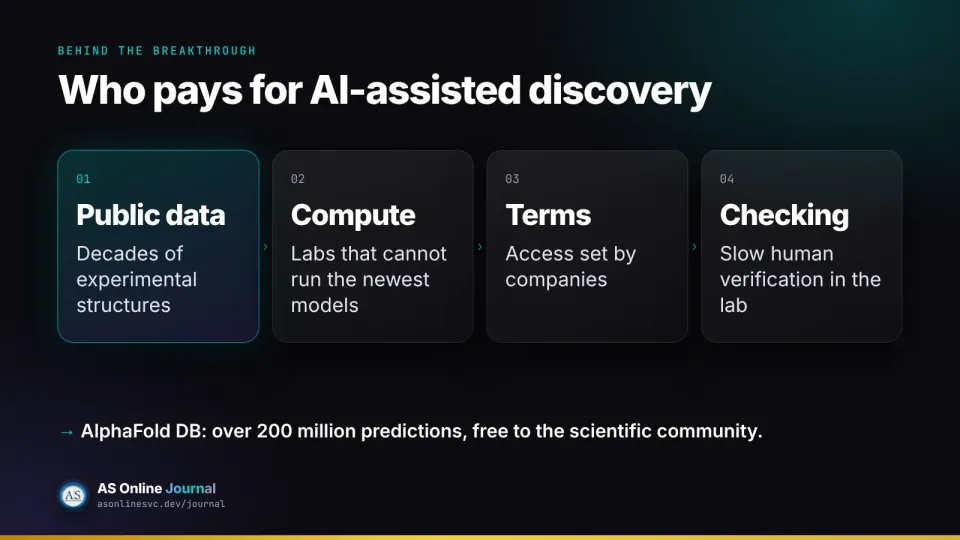
AI models learn from data. Protein structure prediction relied on structures that scientists worked out experimentally and deposited in public archives such as the Protein Data Bank, much of it funded by public research money over decades. That shared, open infrastructure is a large part of why the breakthrough was possible, and it is easy to overlook when credit is given.
Using a free database is cheap. Training or running the newest models is not. Labs and countries with less money for computing can use the outputs but have less ability to build, adapt or check the tools themselves. That can widen gaps between well-funded and less well-funded science.
The newest version, AlphaFold 3, shows the shift. Its code is published under the Apache 2.0 licence, but the model parameters may only be used "if received directly from Google", under separate terms of use. It is also available through the AlphaFold Server "for non-commercial use, though with a more limited set of ligands and covalent modifications". That is a reasonable business choice, but it means a company, not the scientific community, sets the rules of access.
A prediction is not an experiment. AI outputs still need testing in the lab, and the work of checking, which is slow and less celebrated, falls on human researchers.
| Open question | Why it matters |
|---|---|
| Who gets credit for the data behind AI models? | Rewarding data creators keeps open archives going |
| How open should scientific AI tools be? | Openness helps checking and fairness; restrictions may fund development or limit misuse |
| Will AI widen or narrow gaps between rich and poor labs? | Free outputs help; expensive training and closed models may not |
| How should AI predictions be reported in papers? | Clear reporting helps others reproduce and verify results |
There are good arguments on several sides of each, and the answers may differ between fields.
AI-assisted discovery is real and valuable. The fairest version of it gives credit to the public data it learned from, keeps tools open enough for others to check and build on, and funds the slow human work of verification. Those are choices, not defaults, and they decide who shares in the benefits.
Half went to David Baker for computational protein design, and the other half jointly to Demis Hassabis and John Jumper of Google DeepMind for protein structure prediction, the work behind AlphaFold2.
The AlphaFold Protein Structure Database, run by Google DeepMind and EMBL-EBI, makes its predictions freely available to the scientific community. Its latest release contains over 200 million entries.
Partly. Its inference code is published under the Apache 2.0 licence, but the model parameters are only available directly from Google under separate terms of use. It is also offered through the AlphaFold Server for non-commercial use, with some limits.