News & ExplainersExplained

5 min readNew
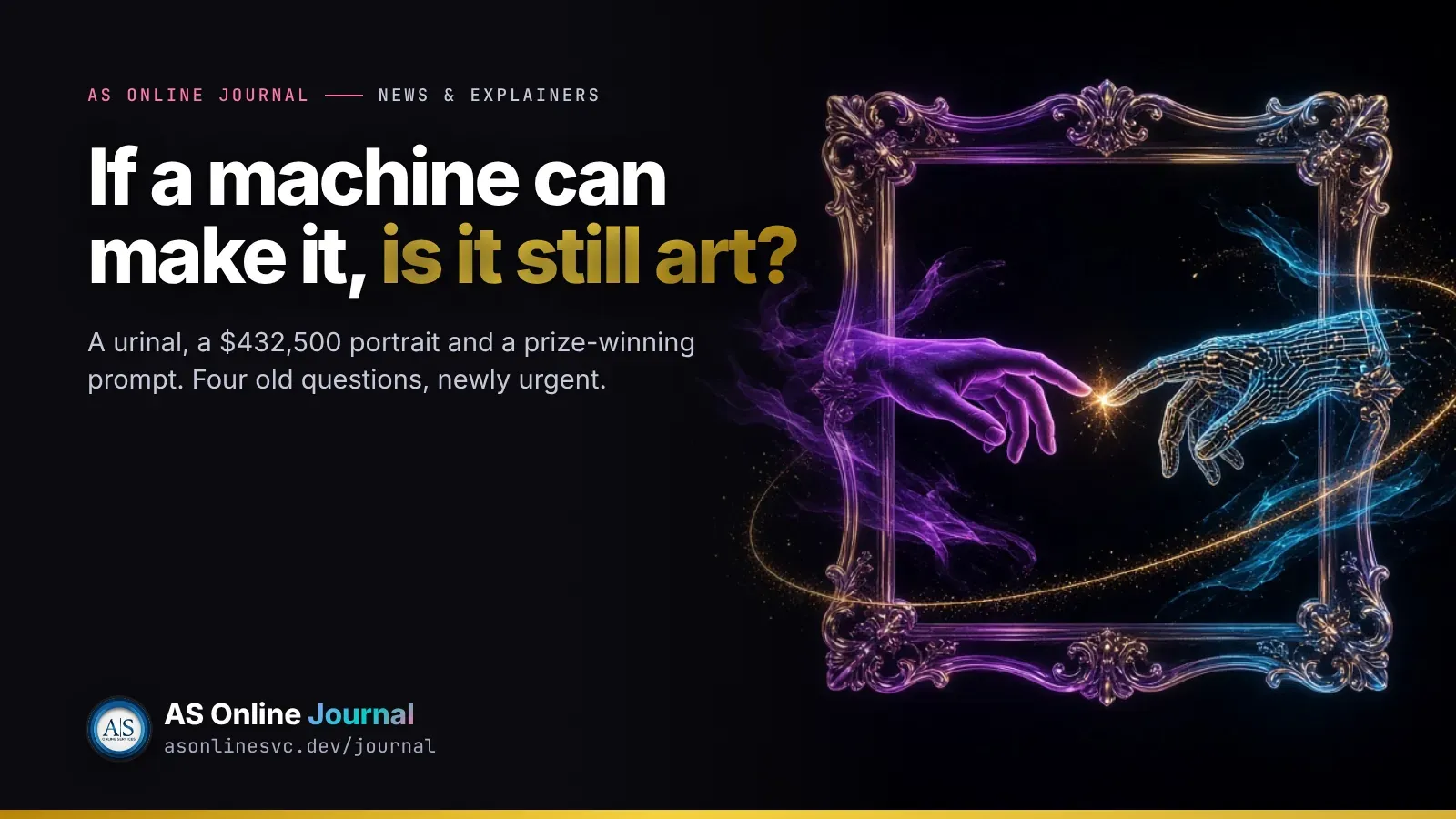
Every time a new tool arrives, someone declares that art is dead. This time the question has court cases, a government report and a prize-winning prompt attached.
In 1859, the French poet Charles Baudelaire wrote a Salon review that read like a restraining order against a new machine. Photography, he said, should go back to its true duty, which was to be the servant of the sciences and the arts, "the very humble servant" (our translation), like printing or shorthand. Let it enter the realm of the imaginary, he warned, and it would soon supplant or corrupt art altogether.
He was right that something big was coming. He was wrong about what it would do to art. Nobody now thinks a photograph cannot be art. The fight did not end because someone won the argument. It ended because enough people made photographs that meant something.
Hold that thought. We will need it by the end.
In 1917, Marcel Duchamp sent a mass-produced urinal, signed "R. Mutt", to an exhibition in New York. The Society of Independent Artists rejected it, and Duchamp resigned. An anonymous editorial in a magazine he ran with friends made the defence, and Tate quotes it:
Whether Mr Mutt with his own hands made the fountain or not has no importance. He CHOSE it.
Read that again with a chatbot open in the next tab. A century before image generators, the art world was told that the act of making was optional, and the act of choosing, naming and framing was where the art lived. Tate describes it as a move from artist as maker to artist as chooser, and often seen as the beginning of conceptual art.
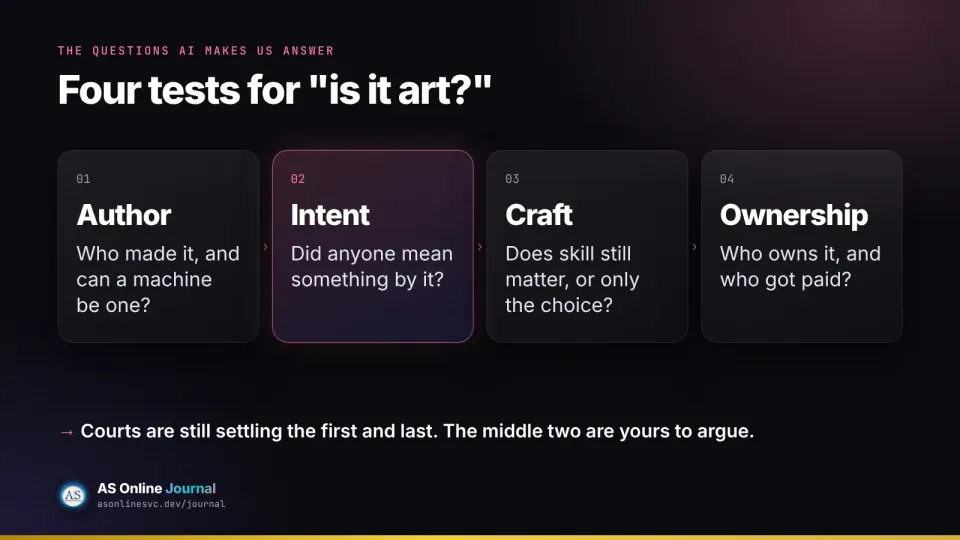
If you take Duchamp seriously, then "a machine made the pixels" settles very little. The better question is who chose, and why.
In October 2018 Christie's sold Portrait of Edmond Belamy, made by the Paris collective Obvious with a generative adversarial network, for $432,500. It was signed with a line of the algorithm's own mathematics. Asked in a Christie's feature whether the artist was the machine, Hugo Caselles-Dupré of the collective replied: "If the artist is the one that creates the image, then that would be the machine. If the artist is the one that holds the vision and wants to share the message, then that would be us."
Law, at least, has picked a side. In the United States, the Supreme Court declined on 2 March 2026 to hear Thaler v. Perlmutter, a case about registering a work its owner said was made by his AI system alone, so the refusal to register it stands. The US Copyright Office has gone further on the messy middle. Its January 2025 report concluded that, "given current generally available technology, prompts alone do not provide sufficient human control to make users of an AI system the authors of the output". Human edits, selection and arrangement can still earn protection.
That is the same logic Jason Allen ran into. His image Théâtre D'opéra Spatial won the 2022 Colorado State Fair's annual fine art competition. In 2023 the Copyright Office's Review Board refused to register it as submitted, because it contained more than a minimal amount of Midjourney-generated content and Allen would not disclaim it. A prize and a copyright are different currencies.
This is the question law cannot answer for you, and it is where we think the whole argument turns.
A model can produce a thousand convincing images before you finish your tea. What it does not have, as far as anyone has shown, is something to say. It has no grief to get out, no grudge, no town it grew up in. Meaning, if it appears, arrives from the person who steered, chose, rejected the first forty results and put the thing in front of us with a title and a reason.
Duchamp would recognise that. So the useful test for a piece of AI-assisted work is not "was it generated?" but "what was decided, and by whom?" A prompt typed in ten seconds and posted without a second thought is closer to a stock photo. A body of work shaped over months, with human choices you can point to, is a different animal. Same tool, different art. This is a view, not a ruling, and reasonable people will land elsewhere.
Here the honest answer is: it counts for something other than it used to.
When an image stops being expensive to produce, hours of skill stop being the proof of seriousness. That hurts people who spent decades earning the skill, and it is fair for them to say so. But Duchamp already unhooked art's value from handiwork, and photography unhooked it from hand-drawn likeness. What tends to survive each shift is whatever is hard to fake: a point of view, a body of work, a visible process, a person you can ask.
Craft does not vanish. It moves. Choosing a lens, editing, composing and knowing what to throw away are still craft, and they are the kinds of human contribution the US Office says can earn protection.
This is where the argument stops being a seminar and turns into a lawsuit.
In the UK, the government's report on copyright and AI, laid before Parliament on 18 March 2026, made two things clear. First, the idea it had floated, a broad exception letting AI developers train on copyright works unless creators opted out, was rejected by most consultation respondents, and is no longer the government's preferred way forward. It says it will gather more evidence and talk to stakeholders about other options. Second, on works made by AI alone, UK law has protected "computer-generated works" with no human author since 1988. The report says that sits uneasily with copyright's purpose of rewarding human creativity, that most respondents wanted it removed, and that the government proposes removing it while keeping protection for works made with AI assistance.
Meanwhile the courts are working through the training question. In Getty Images v Stability AI, the High Court held in November 2025 that the Stable Diffusion model, which "does not store or reproduce any Copyright Works", was not an "infringing copy". Getty dropped its main claim about training at trial because, according to its own court filing as reported by the European film-industry body EuGFA, the training happened outside the UK. The Court of Appeal heard Getty's appeal on 11 and 12 November 2026. We found no published judgment at the time of writing, so the answer on that point is still open.
None of that tells you whether a given image is art. It tells you who gets to make money from it, and that is a decent proxy for what a society thinks a creator is.
Here is where we land. You may not.
The tool is the least interesting part. Baudelaire feared the camera and got the camera wrong. The camera became an instrument, and the art was in what people did with it. AI image and music tools may well follow the same road, producing a flood of forgettable output and, occasionally, work that makes someone stop. What separates the two will not be the software. It will be whether a person stood behind the result and meant it.
If that is right, the pressing question for the rest of us is not "can a machine make art?" It is "when I look at something, how do I tell if anyone is there?" Provenance, disclosure and a creator willing to explain their choices are going to matter more, not less. That is worth asking of any work you buy, share or make.
For the other side of the same shift, the money and the machinery, you might like our look at who pays the hidden cost of AI-assisted scientific discovery.
UK law has, since 1988, protected 'computer-generated works' that have no human author. In its March 2026 report the government said most respondents wanted that protection removed for works created solely by AI, and that, absent evidence of its ongoing value, it proposes removing it while continuing to protect works created with AI assistance. As of that report, nothing had yet changed in law.
Not on a prompt alone, according to the US Copyright Office. Its January 2025 report concluded that, with current technology, prompts alone do not give users enough control to make them the author of the output, though human-made modifications, selection and arrangement can be protected. In March 2026 the US Supreme Court declined to hear Thaler v. Perlmutter, leaving in place the refusal to register a work made without human authorship.
Yes. Jason Allen's Theatre D'opera Spatial, made with the Midjourney image generator and then edited, won the 2022 Colorado State Fair's annual fine art competition. In 2023 the US Copyright Office's Review Board refused to register it as submitted, because it contained more than a minimal amount of AI-generated content that Allen would not disclaim.
No. It is about whether an image-generating model counts as an infringing copy of the photographs it was trained on. The High Court ruled for Stability AI in November 2025, and the Court of Appeal heard Getty's appeal on 11 and 12 November 2026.