News & ExplainersNews brief

3 min readNew
TypeScript's compiler has been rewritten in Go and runs about ten times faster, GCC has a new major version and a policy on AI-written code. What is confirmed, what it means, and the compiler myths to drop.
A compiler turns code people write into something a computer runs, and in doing so it rearranges, removes and rewrites a great deal. 2026 brought three notable changes: TypeScript's compiler was rebuilt in Go and is roughly ten times faster, GCC shipped a new major version, and GCC set out a clear policy on AI-generated contributions. Here is what is confirmed, what is plausible, and which assumptions about compilers are worth dropping.
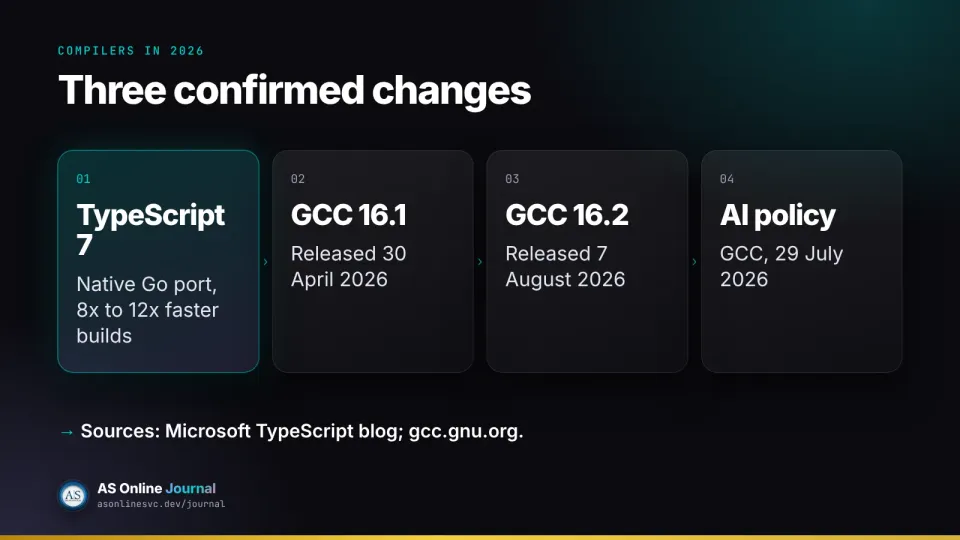
On 8 July 2026, Microsoft announced TypeScript 7, "a 10x faster native port of TypeScript". The team says the port was "done as faithfully as possible", keeping the structure and logic of the original so results stay consistent, and that native code and shared-memory multithreading "typically yield speedups between 8x and 12x on full builds". It installs through npm in the usual way, and editors connect through the language server protocol. A TypeScript 7.1 beta followed on 20 October 2026.
The GCC website lists GCC 16.1 released on 30 April 2026 and GCC 16.2 on 7 August 2026, alongside maintenance releases for older branches (15.3, 14.4 and 13.5). It also notes that an Algol 68 front end was added in November 2025.
On 29 July 2026, GCC announced an AI policy. "For the time being", it declines legally significant contributions that include or derive from LLM-generated content, with exceptions such as test cases. Contributions with LLM-generated content must include an "Assisted-by:" tag, and all must be submitted "by a human who understands the changes and is prepared to answer questions about them".
| Do not assume | Why |
|---|---|
| The compiler runs your code line by line as written | Optimisers reorder, merge and remove code, as long as the visible result is the same by the language's rules |
| Code that "does nothing" stays in | Code with no observable effect, such as clearing a buffer that is never read again, can be removed. Use functions designed for securely wiping secrets |
| Faster compile means faster programs | TypeScript 7 speeds up checking and building; it does not change how your JavaScript runs |
| A new major version is a drop-in upgrade | Major releases can tighten warnings and change defaults. Read the release notes first |
| Undefined behaviour "works on my machine" | In C and C++, the compiler may assume it never happens and optimise accordingly |
Compilers are some of the most trusted software we use, and most of the time that trust is earned. The useful mindset is to treat them as clever, literal-minded partners: they will do exactly what the language rules allow, which is not always what you meant.
Microsoft describes it as a 10x faster native port of TypeScript built in Go, announced on 8 July 2026. It says the port typically yields speedups between 8x and 12x on full builds while keeping results consistent with the original compiler.
GCC's website listed GCC 16.1 as released on 30 April 2026 and GCC 16.2 on 7 August 2026, alongside maintenance releases for older branches.
For now, GCC's AI policy says it will decline legally significant contributions that include LLM-generated content, with exceptions such as test cases. Allowed LLM-assisted contributions must carry an Assisted-by tag.