News & ExplainersNews brief

5 min readNew

OpenTelemetry has graduated, eBPF instrumentation has hit 1.0, and UK and EU incident-reporting rules are tightening. What is confirmed, what is likely, and what is still unknown.
Three things changed in 2026 for anyone who runs software in production. OpenTelemetry, the open standard for collecting traces, metrics and logs, became a graduated CNCF project in May. Its eBPF-based instrumentation, which collects data without code changes, reached v1.0 in October. And the UK's Cyber Security and Resilience Bill, which updates the rules for reporting serious incidents, is in its final parliamentary stages. Here is what is confirmed, what is plausible, and what not to assume.
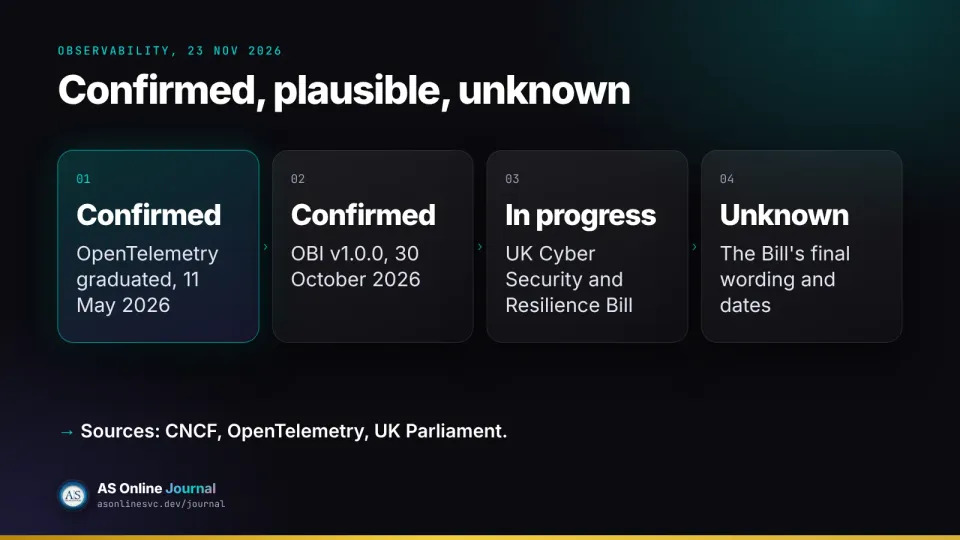
The CNCF's project page says OpenTelemetry was accepted on 7 May 2019, moved to Incubating on 26 August 2021, and moved to Graduated on 11 May 2026. Graduation is the CNCF's highest maturity level. It signals a well-governed, widely adopted project, which matters to organisations choosing a long-term standard.
On 30 October 2026 the project announced v1.0.0 of OpenTelemetry eBPF Instrumentation, or OBI. It "brings OpenTelemetry observability to running Linux applications without requiring changes to their source code". The project says the most important change for users is predictability: documented compatibility commitments for configuration and deployment, and a migration path as telemetry conventions evolve.
Parliament's bill page for the Cyber Security and Resilience (Network and Information Systems) Bill, last updated on 20 November 2026, shows the Bill in its final stages, with the current version, dated 3 November 2026, carrying Lords amendments. Its long title says it amends the Network and Information Systems Regulations 2018. It had not become an Act when we checked.
In the EU, the NIS2 Directive sets staged reporting for significant incidents: an early warning within 24 hours of becoming aware, an incident notification within 72 hours, and a final report within a month.
| Do not assume | Why |
|---|---|
| The UK Bill's final wording and dates | Amendments were still being considered; secondary rules and guidance will add detail |
| Graduation means every OpenTelemetry part is stable | Different signals and language SDKs mature at different speeds; check each component's status |
| eBPF instrumentation replaces code-level tracing | It covers a lot without code changes, but custom business events still need instrumenting |
| More data means better incident response | Without clear alerts and runbooks, more telemetry can slow teams down |
The tooling has matured: open standards and zero-code options are now stable enough to bet on. The regulation is catching up. The gap most teams still have is human: knowing who decides, who reports, and how fast.
Yes. The CNCF says OpenTelemetry was accepted on 7 May 2019, moved to Incubating on 26 August 2021, and moved to Graduated on 11 May 2026.
OpenTelemetry eBPF Instrumentation. The project says it brings OpenTelemetry observability to running Linux applications without changing their source code. Version 1.0.0 was announced on 30 October 2026.
Not when we checked on 23 November 2026. Parliament's bill page, last updated on 20 November 2026, showed the Bill in its final stages, with the latest version carrying Lords amendments.
observability opentelemetry incident-response nis2 uk-cyber-bill