News & ExplainersNews brief
3 min readNew
Faster type-checkers, lazier annotations in Python and government pressure for memory-safe languages. What types really catch, what is confirmed in 2026, and the myths to avoid.
A type system lets a language check, before your program runs, that values are used the way you said they would be. It is one of the cheapest reliability tools available, and 2026 made it cheaper still: TypeScript's new native compiler checks code up to twelve times faster, Python continues to refine how type annotations work, and governments keep pressing for memory-safe languages. But types are a safety net, not a proof that your program is correct.
The TypeScript Handbook describes static type-checking as finding mistakes in code before it runs. In practice that means things like:
What types do not catch is wrong logic. A function that adds when it should subtract is perfectly well typed.
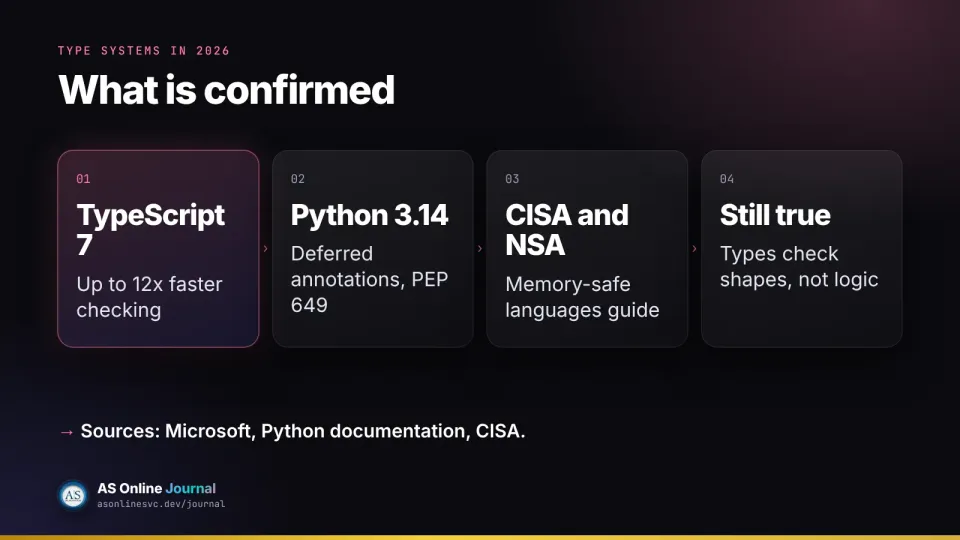
Microsoft's TypeScript 7, announced on 8 July 2026, is a native port of the compiler written in Go. The team reports typical speedups "between 8x and 12x on full builds", while keeping results consistent with the previous compiler. Faster checks matter for reliability because people run them more often, including in editors as they type.
The official What's New in Python 3.14 lists deferred evaluation of annotations (PEP 649 and PEP 749) among the release's biggest changes. In short, type annotations are no longer evaluated as soon as a function or class is defined, which helps with forward references and start-up cost. Python's type hints remain optional and are checked by separate tools rather than by the interpreter at run time.
On 24 June 2025, CISA and the NSA published a joint guide, Memory Safe Languages: Reducing Vulnerabilities in Modern Software Development. It sets out the obstacles to adopting memory-safe languages and practical ways to overcome them, including language-level protections, library support, tooling and training.
| Do not assume | Why |
|---|---|
| Typed code is correct code | Types check shapes, not logic; you still need tests |
| Python type hints are enforced at run time | They are checked by external tools unless you add run-time validation |
| A memory-safe language makes software secure | It removes a major class of bugs, not logic flaws, misconfiguration or weak authentication |
any or type-ignore comments are harmless |
Each one switches the safety net off in that spot |
| Faster checking changes your program's speed | TypeScript 7 speeds up the compiler, not the JavaScript it outputs |
Type systems are one of the best-value tools for reliable software, and they just got faster to use. Treat them as the first line of defence that catches the cheap mistakes early, so that your tests and reviews can focus on the expensive ones.
No. Types catch whole classes of mistakes, such as passing the wrong kind of value, before code runs. They do not check that the logic is right, so tests and reviews are still needed.
Python 3.14 introduced deferred evaluation of annotations (PEP 649 and PEP 749), one of the release's biggest changes according to the official What's New document.
Languages that prevent common memory errors, such as reading past the end of a buffer, by design. In June 2025 CISA and the NSA published a joint guide on adopting them to reduce vulnerabilities.
type-systems typescript python memory-safety software-reliability