News & ExplainersNews brief

5 min readNew
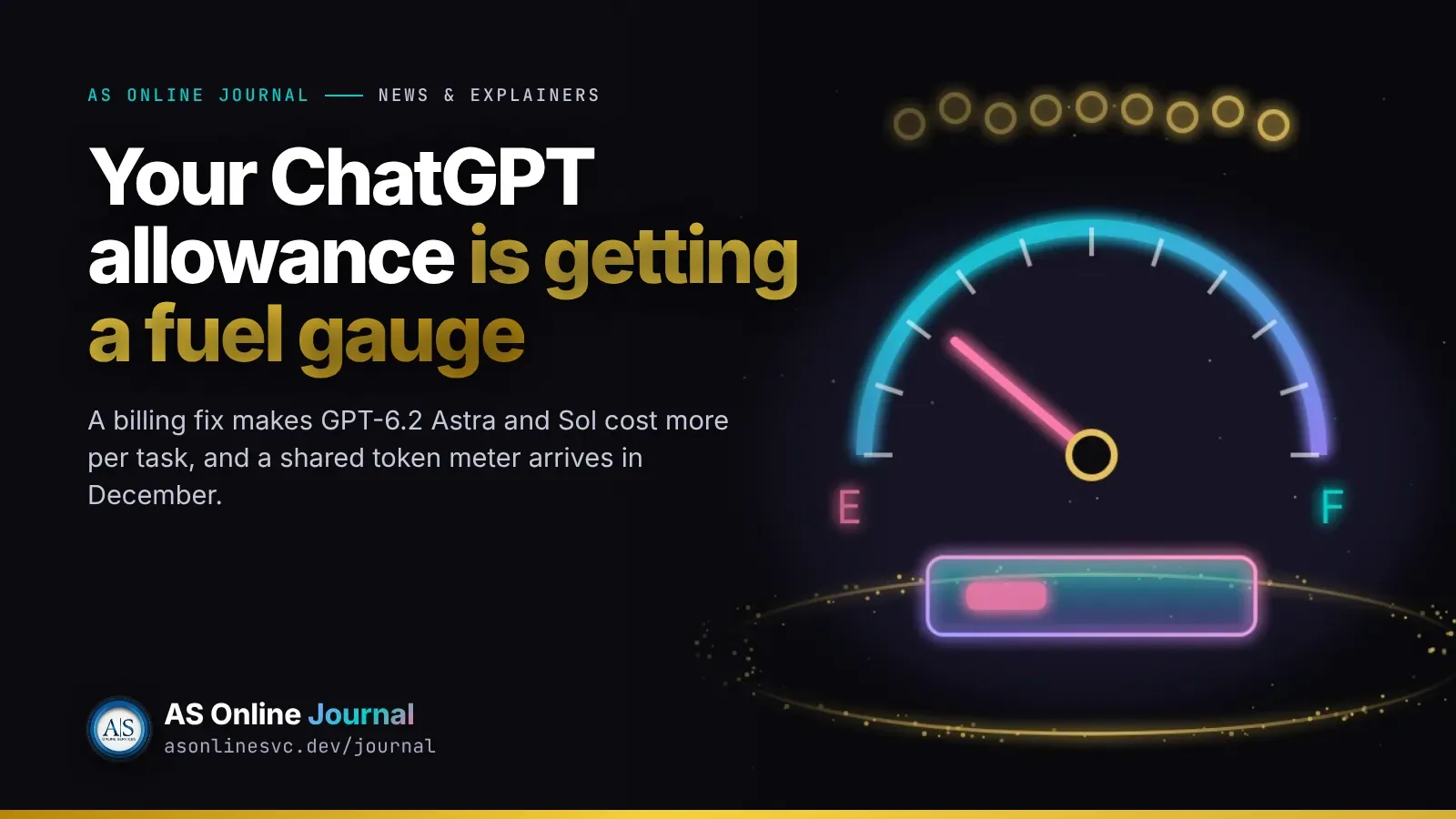
OpenAI fixed a billing mistake that made GPT-6.2 Astra and Sol look cheaper than they are, and from December ChatGPT and Codex will draw on one token-based allowance. What changed this week, what the numbers mean, and what to do.
For about nine days after their launch, OpenAI's two newest models were cheaper to use than they should have been. On 26 November 2026 the company owned up: a billing mistake at the launch of GPT-6.2 had "incorrectly discounted" usage of GPT-6.2 Astra and Sol for most users. It has been fixed. The same work now eats more of your plan.
That would be a small story on its own. It lands in the same week OpenAI confirmed something bigger: from December, ChatGPT and Codex will draw on one shared allowance, measured in tokens rather than messages. Put the two together and the shape of a paid AI plan is changing in front of us. You are no longer buying a number of messages. You are buying a fuel tank whose size you cannot see, and whose fuel burns at different rates depending on what you ask.
The admission came in a post on X from Thibault Sottiaux, who leads engineering for Codex. TechRadar reproduces the post in full. The key lines: "Comparing to last week, you will reach your limits 40% faster on GPT-6.2 Astra and 25% faster on Sol." He adds that both should still go further than their predecessors, GPT-6 Astra and GPT-6.1 Sol, that other models were not affected, and that OpenAI will not charge anyone for the difference on past usage.
By way of apology, OpenAI is "adding one banked reset for everyone on Go, Plus, Pro, and Business". BleepingComputer says the reset appeared in its own ChatGPT account under Settings, Usage, and expires a month after it was added. Business Insider notes that both models launched on 17 November.
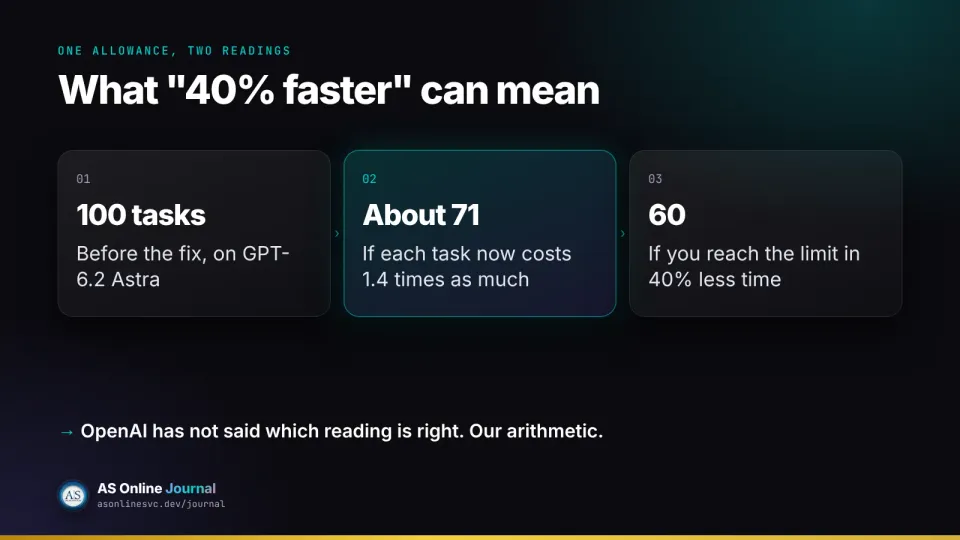
Less than it sounds, and more than a reset fixes. Both TechRadar and BleepingComputer point out that hitting a limit 40% faster is not the same as losing 40% of your allowance. Here is the arithmetic, which OpenAI has not spelled out, so treat it as our reading.
If "40% faster" means each task now costs 1.4 times what it did, then an allowance that used to cover 100 tasks of a given kind now covers about 71. That is roughly 29% less work per allowance on Astra. On the same reading, Sol's 25% works out at 80 tasks instead of 100, or 20% less. If instead it means you reach the wall in 40% less time, the drop on Astra is a full 40%. Sottiaux's post does not say which, and the difference matters to anyone who plans their week around a limit.
Either way, the banked reset is a one-off. It refills the tank once. It does not make the tank bigger.
The second change is on OpenAI's help centre, checked on 27 November 2026. From December, the usage allowance on Plus, Pro and Business plans "will be shared across ChatGPT and Codex as we bring the agentic capabilities of Work into the main ChatGPT experience". Usage will be measured in tokens. How much you burn depends on the model you pick and the task you set, and "more advanced models and complex tasks generally use more of your allowance". Instant chat will not draw from it at all.
OpenAI says it expects most users "won't need to wait for their usage to reset more often than they do now", and that a small group may see the change before December. TechCrunch reported on 25 November that the merged Chat and Work experience had begun reaching a small group of Pro subscribers, and that an OpenAI spokesperson said a small fraction of the heaviest users may hit their limits sooner. The Verge carried the same December timing.
What nobody outside OpenAI knows yet is how big the shared allowance will be. The help page does not say, and none of the reports we read could say either.
Message caps were crude, but you could count them. A token meter is fairer in one sense, because a two-line question costs less than a 40-page document. It is also harder to reason about, because you cannot know in advance what a task will cost, and this week showed the price per task can move after you have paid. A coding session in Codex and a deep research request in ChatGPT will soon empty the same tank.
We do not think that makes the plans bad value. We think it makes them a meter you need to watch, the way you would watch a mobile data allowance. If you pay for one, the habit is worth building now, before December.
Facts in this article were checked against the sources listed below on 27 November 2026. OpenAI says the shared allowance arrives in December and some users may see it earlier; the size of the new allowances has not been published, and details may change.
Not in so many words. OpenAI says it fixed a billing mistake that had been undercounting how much of your allowance GPT-6.2 Astra and Sol used. The allowance is the same, but the same work now uses more of it: 40% faster on Astra and 25% faster on Sol, compared with the week before, according to OpenAI's Thibault Sottiaux. Other models were not affected.
OpenAI says everyone on Go, Plus, Pro and Business gets one banked reset as an apology. OpenAI's help page on resets says a banked reset is used from Usage settings on the web, not the mobile app, only when an allowance it covers has less than 80% left, and that it does not permanently raise your limits. BleepingComputer reports the new reset expires a month after it was added.
OpenAI's help centre says that from December, Plus, Pro and Business plans will share one usage allowance across ChatGPT and Codex, measured in tokens rather than messages. Instant chat will not draw from it. OpenAI says it expects most users will not need to wait for resets more often than now, but has not published the size of the new allowances.
OpenAI says conversations with the Instant model will not count towards the shared allowance, and TechCrunch reports that an OpenAI spokesperson said you can keep using Instant after reaching your limit. The changes mainly bite on the more advanced models, long tasks and Codex.