News & ExplainersExplained

5 min readNew
A laptop often stops being useful before it wears out: when the updates stop, the battery can't be replaced or the parts run out. What the rules and manufacturers actually promise in 2026, and where the gaps are.
Somewhere in a drawer near you there is a laptop that still switches on, still has a working screen and still types perfectly well, and that nobody will use again. It didn't wear out. Something else gave up first: the updates, the battery, or the last available replacement part.
That is the uncomfortable truth about laptop lifespans. The machine can easily outlast the support around it. So the useful question before you buy, or before you bin, isn't "how good is it?" but "who keeps it going, and for how long?" Here are seven questions that get at the answer, with what the rules and manufacturers actually promise, checked on 27 November 2026.
For most people this is the real expiry date, because a laptop without security updates is a risk to put online. It is also the date you are least likely to see on the box.
Windows is the clearest example this year. Microsoft says Windows 10 reached end of support on 14 October 2025. Eligible home PCs on version 22H2 can enrol in Extended Security Updates, free if you sync your PC settings, for 1,000 Microsoft Rewards points, or for a one-off $30 or local equivalent, and that programme now runs to 12 October 2027. Any perfectly usable Windows 10 machine relying on that extension now has a known end date.
Chromebooks are the opposite case: the date is published. Google says Chromebooks get automatic updates for 10 years, and its help page explains how to check a model's schedule. The catch is that the clock starts when the platform was released, not when you bought it, so a cheap Chromebook on clearance may have fewer years left than you think.
Batteries are the part most likely to fade first. The question isn't only whether a new one exists, but whether it is screwed in or glued, and whether the manufacturer will fit one.
Apple is unusually specific. Its service policy says Mac laptops "may be eligible for an extended battery-only repair period for up to 10 years" from when the model was last sold, subject to parts availability. That is a longer promise than it makes for other parts, and it is worth knowing the clock starts at the end of sales, not at launch.
A screen hinge or keyboard failure is a nuisance if you can buy the part and a death sentence if you can't. Apple says owners can get service and parts for at least five years after it last distributed a product for sale, and for up to seven years subject to parts availability; after seven years a product is "obsolete" and service providers can't order parts. Most manufacturers say less, or nothing, in public.
France makes them say it. Since 1 January 2021, laptops sold there must display a repairability score out of 10, the indice de réparabilité. The French government says it is built from five criteria, including documentation, ease of disassembly, how long spare parts are available and their price relative to the product. Apple's own UK page notes that French buyers of Mac laptops bought after 31 December 2020 get seven years of service and parts. A score designed for French shoppers is still a useful public clue for anyone comparing models.
Less than the headlines suggest. The EU's repair directive applies from 31 July 2026. It obliges manufacturers to repair products, even outside the legal guarantee, but only for goods listed in its Annex II, the products that already have EU repairability requirements. Phones and slate tablets are on it. Laptops are not, although the Commission can add products when it adopts new rules. One part does apply widely: if you choose repair as the remedy for a fault, the seller's liability is extended by 12 months.
The UK has its own rules, from 2021, often called the right to repair. The regulations set spare-part and repair-information duties for products such as dishwashers, washing machines and televisions. Laptops aren't covered. So for laptops in the UK, longevity is still mostly a matter of what the manufacturer chooses to offer, and what UK consumer law says about faulty goods.
This sounds like a question for enthusiasts, but it is really about whether the laptop can grow with you. A machine with soldered memory and storage is fixed at the spec you bought. Many thin laptops are built this way, and that is not a defect, just a trade-off for size. If you keep machines for a long time, buy closer to the spec you will need in five years, or choose a model whose parts can be swapped. A repair score, such as France's, often reflects this.
Hardware requirements end lives too. Windows 11 has minimum hardware requirements, including a TPM 2.0 security chip, that some older PCs do not meet, which left some owners facing the Windows 10 deadline with a working machine that couldn't make the jump. When you buy, check that the laptop meets the current requirements comfortably, not barely. For a second-hand machine, check before you pay.
A laptop past its supported life isn't automatically scrap. Options include a lighter operating system, a role that doesn't need the internet, or passing it to someone who will repair it. Wipe it properly before it leaves your hands. Those choices are better made deliberately than by leaving it in a drawer until the battery swells.
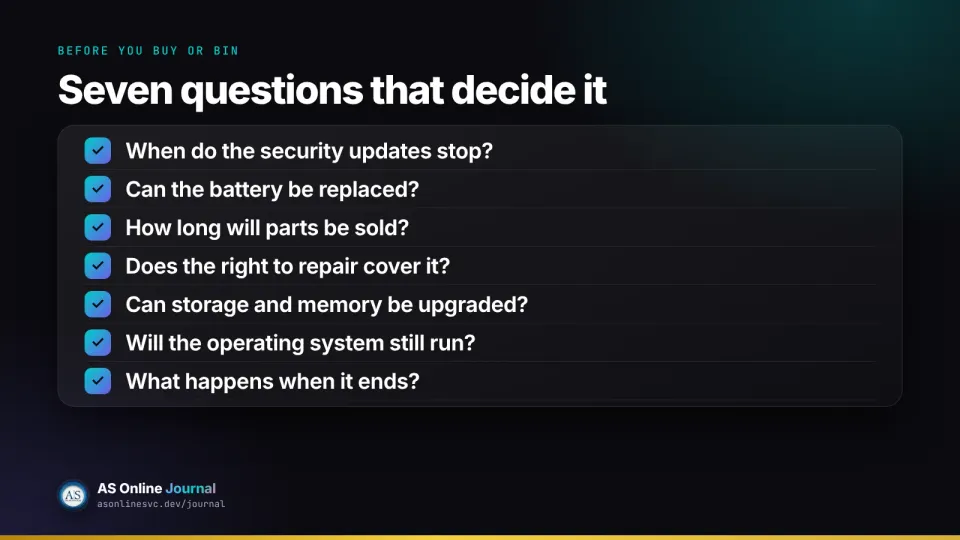
We tend to buy laptops on what they can do today: the screen, the chip, the weight. The questions above are about what the laptop will be allowed to do in year five, and they are mostly answered by companies and regulators, not by the hardware. That means the most valuable spec sheet is often a support page. Before your next purchase, spend ten minutes finding the update date, the battery policy and the parts promise. They will tell you more about how long it lasts than the benchmark scores.
There are still open questions. Will the EU add laptops to its repair list? Will the UK extend its 2021 rules? We don't know yet, and we will update this piece when either happens.
Facts in this article were checked against the sources listed below on 27 November 2026. Support dates, policies and laws change; check the current version for your model and country.
Not yet. The EU repair directive (2024/1799), which member states had to apply from 31 July 2026, obliges manufacturers to repair only the products listed in its Annex II, which are products with EU repairability requirements. Laptops are not on that list, although the Commission can add products when it adopts new requirements. The directive's 12-month extension of seller liability when you choose repair applies to goods generally.
Not as such. The UK's 2021 ecodesign regulations, often called right to repair rules, set spare-part and repair-information requirements for products including dishwashers, washing machines and televisions. Laptops are not among them. UK consumer law still gives you rights when goods are faulty, but that is a different thing.
Apple says owners can get service and parts for a minimum of five years after it last distributed a product for sale, and for up to seven years subject to parts availability, with battery-only repairs for Mac laptops for up to ten years, subject to parts availability.
Google says Chromebooks get automatic updates for 10 years from the date their platform was released, which is not the same as the date you buy one. You can check a model's date in its settings.