
News & ExplainersExplained

6 min readNew
Data centres use water twice: once to cool the servers and again, out of sight, to generate the electricity. The argument over AI's thirst is mostly an argument about what gets counted.
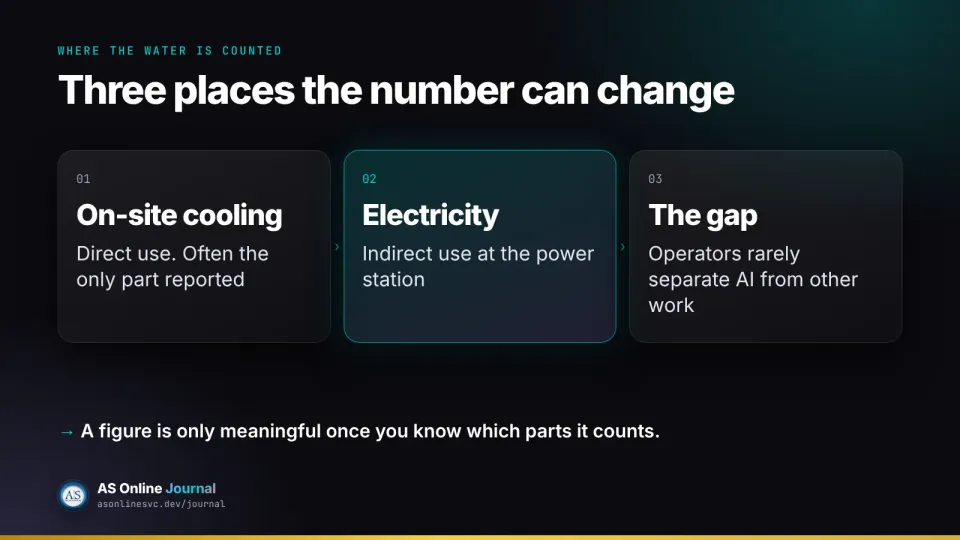
Every conversation with an AI system depends on a building full of servers that must be kept cool, and on power stations that, in many places, also use water. The disagreement over how much water that adds up to is real and not yet settled. Part of it is a measurement problem: it matters whether you count only the water used on the site, or also the water used to generate its electricity. Part of it is a disclosure problem, because operators often do not say. And part of it is local: a small national share can still be a large share of one river catchment.
A peer-reviewed paper in the journal Patterns by Alex de Vries-Gao of VU Amsterdam, published in December 2025, separates them:
The paper notes that Meta is the only company in its comparison to report water embedded in purchased electricity, and that Meta's indirect figure is significantly higher than its direct one. It also reports that Google chose not to report indirect water consumption for its Gemini model because it "does not fully control the water consumption in electricity generation", which the author calls a reluctance to disclose a metric that is a consequence of the company's electricity use.
Why does this matter? Because a figure that counts only cooling water can look small beside one that includes power generation, and both can be described as "AI's water use".
The same paper argues that the International Energy Agency's estimate for all data centres in 2023, about 140 billion litres direct and 373 billion litres indirect, may be too low on the indirect side. Using disclosures from Meta, Apple and Google, it estimates a higher water intensity of electricity. For AI alone, it suggests a global water footprint between 312.5 and 764.6 billion litres in 2025, and compares that range with the world's annual consumption of bottled water.
Read that carefully. It is one researcher's estimate, built on approximations, because the author says operators do not separate AI workloads from others and publish inconsistent data. The paper itself calls for more disclosure to improve accuracy. The range is wide because the evidence is thin. Neither the low nor the high end should be quoted as a measured fact.
There is a serious counter-argument, and the UK Government makes much of it. In its written statement of 28 October 2026, it says evidence suggests current data centre water use is a relatively small proportion of overall non-household consumption, estimated at less than 0.2% of the non-household sector in England, and that many facilities in England already use highly water-efficient cooling.
That is worth taking at face value. Cooling designs differ, and some use very little water.
The same statement then adds three complications.
1. Growth and place. It says the rate of potential future growth, "particularly in areas already experiencing water stress that are more adversely affected during hotter periods", means greater action on controlling water use is crucial. A national average hides local stress. The Government's own National Framework for Water Resources says large data centres can consume millions of litres a day, with use rising in summer, and that a lack of water can push a data centre to less efficient cooling methods that use more energy.
2. A trade-off, not a fix. The statement says energy and water use are closely linked and that cooling can involve trade-offs: some technologies reduce energy consumption but increase water demand. Saving water in one place can cost electricity in another, which is itself an indirect water cost.
3. No obligation to supply. It notes that water companies do not have to supply data centres with water, so early engagement by developers is essential.
The statement strongly encourages operators to publish annual reporting that includes total and peak water use and their Water Usage Effectiveness (WUE), alongside energy and carbon metrics. It expects the sector to do so voluntarily, and says that if enough data is not provided, the Government will immediately consider a statutory reporting framework. It also asks developers to follow a water-use hierarchy: reduce demand first, use recycled water second, and rely on additional freshwater only if neither can meet operational needs.
Our view is a narrow one: the right response to a contested number is better measurement, not a confident quotation of either end. That includes our own figures: every number above is attributed to its source and should be read with its caveats.
Figures and statements were checked against the sources listed below on 25 November 2026.
Nobody knows precisely. A peer-reviewed estimate published in the journal Patterns in December 2025 suggested that AI systems alone could have a water footprint of 312.5 to 764.6 billion litres in 2025, but the author stresses large uncertainty because operators do not separate AI from other workloads.
On current evidence, not nationally. The UK Government's 28 October 2026 statement says data centre water use is estimated at less than 0.2% of the non-household sector in England, but warns that future growth in water-stressed areas makes greater action on controlling water use crucial.
It is a measure of how much water a data centre uses relative to its energy use. The UK Government has asked data centre operators to publish total and peak water use together with their WUE, and says it will consider a statutory reporting framework if voluntary disclosure falls short.