
News & ExplainersExplained

5 min readNew

Bookmakers already run models of their own. A handful of syndicates once found a real edge. Most tipster bots will not beat the margin, the market, or a shrinking account.
A computer can price a horse race. Bookmakers, exchanges and the firms that supply them already do this every day, using models that move prices as bets arrive and as a race unfolds. A small number of well-documented syndicates have also beaten large betting pools with statistical models, most famously Bill Benter's operation in Hong Kong, as he described in 1994 and again to Bloomberg in 2018. That is not the same as saying AI beats the bookies. The margin baked into the prices, the information already in the public odds, the short samples behind most tipster claims, and the way UK bookmakers restrict winning accounts all still sit between a clever model and a reliable profit.
The useful starting point is not a tipster bot. It is the sportsbook itself.
Fixed-odds bookmakers estimate the chance of each outcome, add a margin, and then manage the risk as money comes in. If too much is staked on one horse, the price shortens, the alternatives become more attractive, and the book is less exposed if that horse wins. On a betting exchange there is no house book in the same way: backers and layers bet against each other, and the exchange takes a commission. In both cases, price and risk are now handled at a scale no human trading desk can cover by hand.
Trade publication iGaming Business reported in April 2024 that two of the biggest sports data firms had launched automated pricing tools for this job. Sportradar's Alpha Odds, first launched in 2022, was described by the company as a way for a sportsbook to generate prices that reflect its own risk and liabilities. Genius Sports launched a similar product, Edge, in January 2024. Darren Small, then of Sportradar, told iGB that the system was doing at scale what a single trader might once have done on a single match, with a liability team still overseeing how each client was configured. Those are company descriptions, reported in the trade press, not an independent audit of anybody's edge.
A BBC report in March 2024 looked at the same shift from the other side of the counter. EquinEdge, a firm that sells analysis to punters, said its system used AI on horse performance, track conditions, and jockey and trainer statistics to estimate the chance that a horse would win. Other suppliers, the BBC reported, were using AI to personalise what a customer is shown, and to flag behavioural patterns that might indicate harm. Zoë Osmond, then chief executive of GambleAware, said that talk of using AI to improve the customer experience needed to be "carefully offset and managed" so that it also helped prevent gambling harm. The models are not only trying to beat a race. They are also trying to run a book, and a customer relationship, at industrial scale.
The story that still hangs over this field is older than the current wave of AI products, and it is well documented.
In May 2018, Bloomberg, also published by The Straits Times, reported Bill Benter's account of a computer betting operation in Hong Kong. Horse racing there is pari-mutuel: everyone bets into a pool, winners share what is left after the operator takes a commission, which the 2018 report put at about 17 per cent. Benter's problem was not just to pick winners. It was to find bets whose advantage was bigger than that cut.
He built on an academic idea from the mid-1980s: a multinomial logit model, set out in a paper called "Searching for Positive Returns at the Track", which treated a horse's chance as a weighted combination of measurable factors such as speed, form and jockey skill. Benter arrived in Hong Kong in September 1985 with early IBM computers. The first season, ending in 1986, went badly: he and his then partner, Alan Woods, had lost 120,000 US dollars of a 150,000 dollar stake, according to the same report.
The later breakthrough, Benter told Bloomberg, was not to invent a private set of odds from scratch. It was to start with the Hong Kong Jockey Club's public betting odds, which already summarised a huge amount of informed opinion, and to refine them with his own model. He called that his most important innovation, and said that in the 1990-91 season he won about 3 million US dollars. In his 1994 paper, "Computer Based Horse Race Handicapping and Wagering Systems: A Report", Benter wrote that he had run such a system for five years, with a net profit in four of the five seasons, and a loss of about 20 per cent of starting capital in the other. He presented that as evidence that the pari-mutuel market was not perfectly efficient.
The 2018 report also described a later moment on 6 November 2001, when Benter and colleague Paul Coladonato hit Hong Kong's Triple Trio, a bet that requires the first three horses, in any order, in three races. Their software had placed 51,381 combinations. One of them was correct, and the jackpot, the report said, was 16 million US dollars. Asked later about the overall scale of the operation, Benter said it had probably made close to a billion dollars, with some of that going to partners, and added: "Unfortunately, I'm not a billionaire."
That history matters, and it has limits. It is one documented operation, in a particular kind of pool, over many years, with a large bankroll and a model that was rebuilt continuously. It is not a result you can paste into a weekend app. Bloomberg also noted that as more computer syndicates appeared, the Jockey Club published more technical data, and that Benter, still betting decades later, said he could see the odds move in the seconds before a race as the computer teams all bet at once, and that he was amazed he could still win. The edge, if it still exists, is being hunted by people who look a lot like each other.
Strip away the branding, and a serious horse racing model is a probability engine. It tries to answer a dry question: given everything we can measure, how often should this horse win, and is that different from the price on offer?
The raw material is mostly public, or sold as data, rather than mysterious. Recent form and finishing positions. The going, meaning how testing the ground is: Timeform, whose founder Phil Bull once called going "the most important consideration of all", has long argued that official going descriptions can lag behind the surface as a meeting unfolds, and that overall times and sectional times, the splits within a race, are a better objective check. Sectional times also say something about pace: a horse that finished strongly after a slow early sectional has run a different race from one that led and faded. Then come the usual handicapping factors: distance, course, weight, draw, jockey and trainer, and how a horse has performed in similar conditions before.
The market itself is often the most powerful input. Benter's own lesson was that the public odds already contain a lot of information, and that the model's job is to find the residual: the places where its probability and the market's implied probability still disagree. Late market moves can be a signal, or a trap. They may reflect informed money, a change in the going, a withdrawal, or simply a surge of casual bets. A model that chases every move is not analysing the race. It is following the crowd.
None of this requires a large language model, and a chatbot that "has a feeling" about the 3.30 is not a substitute for a fitted probability. The current fashion is to wrap older statistical machinery, or a newer machine-learning model trained on the same kind of inputs, in the word "AI". The label does not change the test: over a long enough run, does the model's probability beat the price after the margin is paid?
Three structural problems sit in the way, even before anyone opens an account.
The first is the margin. In a bookmaker's prices, the implied probabilities of all the outcomes add up to more than 100 per cent. The excess is the overround, the built-in house advantage. In a pari-mutuel pool, the equivalent is the take-out: in the 2018 Bloomberg account of Hong Kong, about 17 per cent. A model does not beat the odds by being a bit better at picking winners. It has to be more accurate than the market by more than that margin, consistently. Otherwise the house still wins slowly, even if a few Saturdays look brilliant.
The second is that the market is not a fool. Public odds already aggregate form students, professional money and, increasingly, other models. Benter's 1994 paper argued that the Hong Kong pools of his era were inefficient enough to beat. That was a claim about a specific market at a specific time, after years of work. As more well-resourced teams have entered, and as bookmakers have automated their own pricing and risk, the leftover scraps get smaller. A short run of winning tips is what you would also expect from luck. Without a large sample, and without a clear record of the actual prices that were available when the tip was issued, it is not evidence of an edge. The UK Advertising Standards Authority has made a similar point for years: tipsters who advertise past profits should "proof" those tips with an independent body, in advance, and should not imply that success is guaranteed.
The third is sample size, which racing makes unusually unkind. A horse runs a handful of times a season. Conditions change. A model fitted on last year's data can look superb until the ground, the field size or the pace profile shifts. Overfitting, the classic vice of a model that has memorised the past, shows up as a beautiful back-test and a poor next month. If a service cannot show a long, independently recorded run at realistic odds, after commission, the safe assumption is that it has not beaten the market.
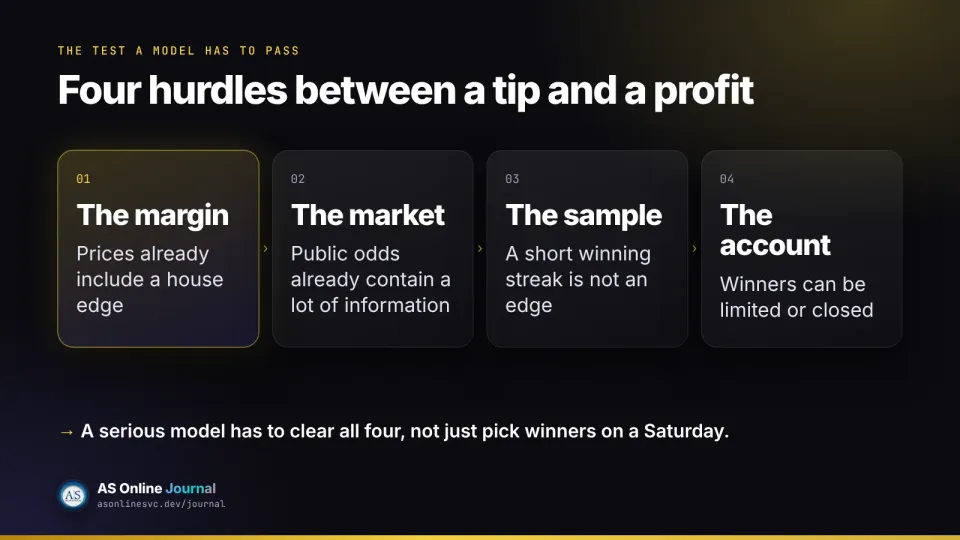
Even a real edge can be hard to use. UK bookmakers are entitled to manage their own liabilities. The Gambling Commission put it plainly in July 2025: there is no statutory right to bet, and "being a successful bettor is not a protected characteristic in discrimination law."
That is not a rumour from racing forums. It is in the Commission's own data. In a request covering almost 15 million active accounts at some of the largest online real-event betting providers, for calendar year 2024, operators reported that 4.31 per cent of those accounts had been commercially restricted in some form. The most common tool was a stake-factor cut, which limits how much you can bet as a fraction of the usual maximum: 2.68 per cent of active accounts had one. Another 2.23 per cent were closed for commercial reasons. Among restricted accounts, a much higher share were in profit (46.78 per cent) than among active accounts as a whole (25.42 per cent). The Commission also found that when stake factors were applied, they were often severe: of the reported bands, 36.22 per cent were limited to between 1 and 9 per cent of the unrestricted maximum, and 22.41 per cent to 1 per cent or less.
The practical effect is simple. A model that is only allowed to bet a few pounds cannot turn a small percentage edge into a living, and a closed account cannot bet at all. Some operators, the Commission noted, do not close accounts for commercial reasons. Transparency, it said, still matters: licensed operators should tell customers, at the start and throughout, how and why an account might be restricted.
If the real work is slow, statistical and often un-stakable, the marketed version is usually the opposite.
On 14 October 2026 the Advertising Standards Authority upheld a ruling against a paid Facebook ad for AI Scorecast, an app that used AI to forecast football results. The voiceover claimed a "97% accuracy rate", "high odds betting slips entirely powered by AI", and that the speaker had tried it on "six matches all correct". The ASA judged that consumers would take this as a claim that they were very likely to make a profit by following the app, and that the ad did not mention the possibility of losing. It ruled the ad misleading and irresponsible, and said it must not appear again in that form. The advertiser did not respond to the ASA's enquiries.
That ruling sits on well-worn ground. The ASA's advice to tipsters, last updated in May 2025, is blunt: do not imply that success is guaranteed, do not imply that past winnings are typical, and only advertise previous wins that were registered with an independent body before the event. "AI" does not relax those rules. A screenshot of a winning slip, a chatbot with a confident tone, or a weekend of lucky results is not a track record.
One piece of British context is often blurred, and it is worth keeping straight. The Gambling Commission has said, repeatedly, that it is not introducing "affordability checks". In an April 2026 blog on its financial-risk-assessment pilot, it wrote: "This is not an 'affordability check' as the check proposed would make no assessment of a customer's income or how much an individual could afford to gamble. There are no proposals or plans to introduce affordability checks."
What it is introducing, in stages, are Financial Risk Assessments: document-free checks, using credit-reference data, to flag high-spending remote customers who may already be in financial difficulty, such as significant arrears, defaults or bankruptcy. In July 2026 the Commission confirmed a staged rollout. On 17 November 2026 it said it would confirm the Stage 1 timetable by the end of the year. Stage 1 is planned for the largest operators, and for most customers aged 25 or over it would be triggered by net deposits of more than £5,000 in a rolling 24-hour period, or £2,500 for younger customers. Those thresholds are triggers for an assessment, not a cap on what someone is allowed to bet. The Commission has also said that, once fully in place, assessments would still apply only to a small minority of accounts.
That is a safer-gambling policy, not a judgement on whether a model can beat a price. It should not be described as an affordability test when the regulator has said it is not one.
So can AI beat the bookies? Sometimes, in the narrow, well-documented sense that a carefully built model, with enough data, capital and time, has beaten a particular betting market. Bookmakers and their suppliers now run models of their own, which makes that job harder, not easier. For most people offered an "AI tip" this weekend, the better bet is that the overround, the public odds, a small sample and, if they ever did win, a shrinking account limit will get there first.
This article is not betting advice, and it is not a tip. We have not tested any model, service or bookmaker, and we are not recommending that anyone gamble.
You must be 18 or over to gamble in Great Britain.
If you are worried about your own gambling, or someone else's, independent help is available. GambleAware is at begambleaware.org, which now redirects to gambleaware.org. GamCare's National Gambling Helpline is free and open 24 hours a day on 0808 8020 133 in England and Scotland (in Wales, 0808 2819 265). Both the number and the GambleAware address were checked on 25 November 2026.
There is no good evidence that it can, as a general rule. A small number of well-documented syndicates have found an edge in specific betting pools, over many years, with a lot of data and capital. Most marketed tipster tools do not show that they beat the bookmaker's margin over a long, independently recorded sample, and UK bookmakers can restrict or close winning accounts.
Yes, according to sources that can be checked. Bill Benter described the system in a 1994 paper, reporting a net profit in four of five seasons, and told Bloomberg in 2018 how he refined the public odds with his own model. That is a documented historical case, not a promise that a modern app will do the same.
The Gambling Commission says operators may manage their commercial liabilities, and that there is no statutory right to bet. Its 2025 data request found that 4.31 per cent of almost 15 million active accounts had been commercially restricted, including stake limits and closures, and that restricted accounts were more likely to be in profit than accounts as a whole.
The Gambling Commission has said it is not. It is introducing Financial Risk Assessments, which use credit-reference data to flag high-spending remote customers who may already be in financial difficulty. It has been explicit that this is not an assessment of income or of how much someone can afford to gamble, and that Stage 1's timetable was still to be confirmed at the end of 2026.