How to organise a side project without promising yourself an income
Score the idea on what you actually have, plan a small calendar, log your real hours, and keep the money records HMRC expects.
By AS Online Journal · 7 min read Published · Updated
In short
Most side projects do not stall for lack of ambition. They stall because the plan was a revenue fantasy instead of a list of next steps. Score your idea on what you actually have, keep a small content calendar, log your real hours, and record only money you have already spent. Know the basic UK tax rules before you sell anything, and leave the forecasts out.
The problem with "side hustle" planning
Search for side-hustle advice and you will mostly find promises: a figure per month, a number of weeks to "replace your salary", a screenshot of someone else's dashboard. None of that tells you whether your idea suits your evenings, your skills or your budget.
A better question is smaller: what is the next version of this I can finish, given the time I really have? That is a planning problem, and planning problems are solved with a few honest lists.
If you want those lists ready-made, we publish our own AS Online product, the AI Side-Hustle Planner, for £12. Everything below works with a notebook or a blank spreadsheet.
Step 1: score the idea on what you actually have
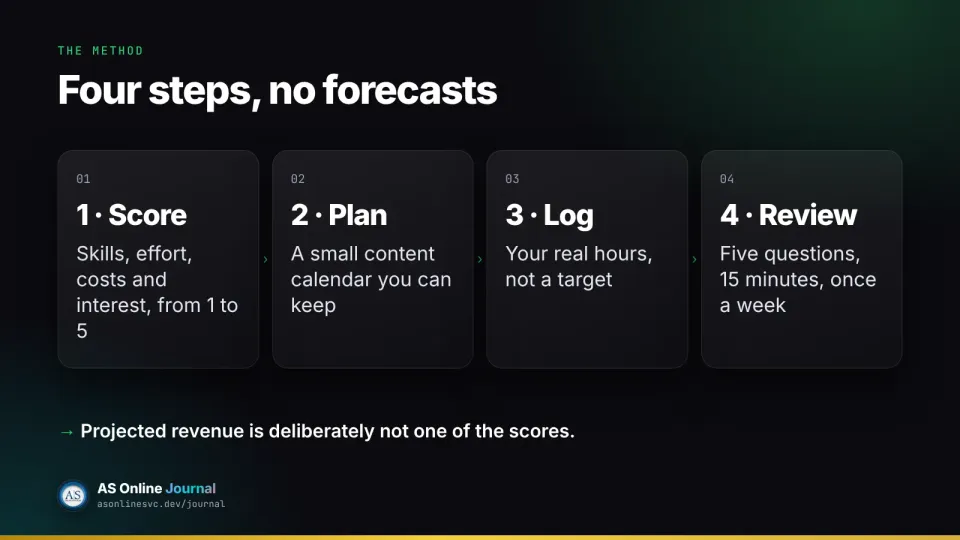
Give each idea a score from 1 (low) to 5 (high) on four questions. Projected revenue is deliberately not one of them.
Comparison at a glance
Question
What a 5 means
What a 1 means
Skills you already have
You could start the first version this week
You would need to learn the basics first
Effort for a first version
Small and finishable in a few sessions
Months of work before anyone sees it
Costs to start
Little or nothing to spend up front
Equipment, stock or software before you begin
Personal interest
You would come back to it on a tired Wednesday
You like the idea of it more than the work
There is no total that means "go". A high interest score with a low skills score is useful information, not a green light. It tells you the first month is for learning, which changes what a sensible first version looks like.
A worked example
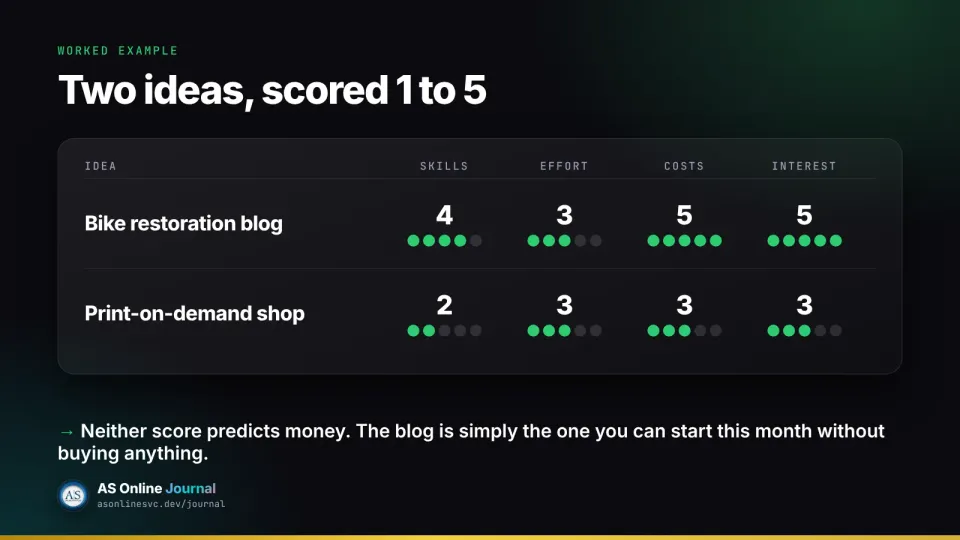
Say you are weighing two ideas: a how-to blog about restoring old bikes, which you already do, and a print-on-demand shop, which you have never tried.
Bike blog: skills 4, effort 3, costs 5 (you already have a laptop), interest 5.
Neither score predicts money. But the blog is plainly the one you can start this month without buying anything, which is a reasonable reason to start there.
Step 2: a content calendar you can keep
Plan four weeks, not a year. A calendar you abandon in week two is worse than none.
Keep just five columns: date, title or idea, channel (blog, email, shop or other), status (idea, drafted, published or skipped) and notes. The "skipped" status matters. It lets you record a missed week honestly instead of quietly deleting the row.
Pick a pace you could keep in a busy month. One post a fortnight that actually appears beats three a week that do not.
Step 3: log your real hours
A time log is the most underrated tool in a side project. It needs four columns: date, activity, minutes and notes.
Record time already spent, not targets. After a month you will know things no planning template can tell you, such as how long a post really takes you, or that "admin" is eating half your sessions.
Step 4: a weekly review in five questions
Once a week, for 15 minutes, answer:
What did I say I would do?
What did I actually do?
What did I learn?
What will I do next week?
What will I deliberately not do?
The fifth question is the one that keeps a side project small enough to survive.
Where an AI assistant helps (and where it does not)
An assistant can tidy your notes, suggest a structure for a post or help you word a product description. It can also be confidently wrong. OpenAI's own help page warns that ChatGPT can invent facts and sources and sound sure while doing it.
Two prompts that stay on the right side of that line:
Here are my rough notes for a blog post about [topic].
Suggest a heading structure with one sentence per heading.
Use only what is in my notes and mark any gap as "needs
checking". Do not add statistics.
Here is my time log for the last four weeks. Group the
activities into five categories and total the minutes for
each. Do not interpret it or make predictions.
Assistants can add up wrongly, so check any total against the spreadsheet itself. In Excel or Google Sheets, =SUM(C:C) typed in an empty cell to the right of the table totals a Minutes column in column C.
Do not ask an assistant how much your idea will earn. It does not know, and any number it gives you is a guess dressed up as an answer.
The UK money basics: records, not forecasts
Planning without income promises does not mean ignoring money. It means recording what has really happened, which is also what HMRC expects.
According to GOV.UK, you are likely to be trading if, for example, you sell regularly to make a profit, make items to sell, or are paid for a service you provide. You can run a business and be employed at the same time. If you only sell things occasionally, GOV.UK has a separate check for whether you need to tell HMRC.
HMRC's trading allowance is a tax exemption of up to £1,000 a year. GOV.UK says that if your gross trading income is £1,000 or less you may not need to tell HMRC, although there are exceptions. If it is more than £1,000, you must register for Self Assessment, by 5 October after the end of the tax year, and you can then choose to deduct the £1,000 allowance instead of your actual expenses. GOV.UK also says you cannot use the allowance on income from your employer (or your spouse's or civil partner's employer), from a company you or someone connected to you controls, or from a partnership where you or someone connected to you is a partner. Either way, you must keep records of the income, such as invoices, a spreadsheet of receipts or bank statements.
So keep two simple logs from day one:
Expenses: date, item, amount, category, notes. Only money already spent.
Income: source, date received, amount, what it was for, notes. Only money already received.
This is general information from GOV.UK, not financial or tax advice. If you are unsure whether you are trading, HMRC says to contact it.
Putting it in Notion or a spreadsheet
Five small tables (ideas, calendar, time log, expenses and income) and a review page work fine in Excel or Google Sheets. If you prefer Notion, its help centre says a CSV import turns each row into a database item and each column into a property, with the first column as each item's title. Imports run on desktop and web, not mobile yet, and a CSV import adds new rows rather than updating existing ones. After importing, check that date columns came in as dates and that minutes and amounts are Number properties; you can then show a total at the foot of a column with Calculate, then Sum.
A product from AS Online
This article is paired with our own product, the AI Side-Hustle Planner, at £12. It is not a third-party offer and it does not include a software login.
It is a PDF and EPUB guide with worked examples, plus five CSV files (ideas scored on skills, effort, costs and interest, a content calendar, a time log, and logs of money already spent and already received) and a weekly review page in Markdown. It is a record-keeping aid, not financial or tax advice. You can import the CSVs into Notion or open them in a spreadsheet. It is not a one-click Notion template, and it does not promise income, clients or a "side income".
Do I have to tell HMRC about a small side project?
It depends. HMRC's trading allowance means you may not need to tell it about gross trading income of £1,000 or less in a tax year, but there are exceptions, and you must keep records. Above £1,000 you must register for Self Assessment. Check GOV.UK or contact HMRC for your own situation.
Can I import a CSV planner into Notion?
Yes. Notion's help centre says a CSV import turns rows into database items and columns into properties. Imports are on desktop and web, not mobile, and a CSV import adds rows rather than updating existing ones.
Should I forecast how much my side project will earn?
This article does not recommend it. A forecast for a project that does not exist yet is a guess. Record what you have actually spent and the hours you have actually worked instead.