News & ExplainersExplained

5 min readNew

Terraform, Redis and Elasticsearch changed their licences, two came back, and the EU's Cyber Resilience Act now has dates. Here is what is confirmed, and how to check your own stack.
Over the past few years several well-known infrastructure projects moved away from open-source licences, and two of them later added one back. The pattern is real, but it does not mean "open source is ending". What it does mean is that a licence is a dependency like any other: it can change at a major version, and you should know which ones your work relies on. Separately, the EU's Cyber Resilience Act now has fixed dates, with reporting duties from 11 September 2026 and the main obligations from 11 December 2027.
These are the changes that are on the record from the projects themselves, not from commentary about them.
| Project | What changed | Where it stands |
|---|---|---|
| Terraform (HashiCorp) | Moved from the Mozilla Public License to the Business Source License in 2023 | The community fork OpenTofu, now a Linux Foundation project, describes itself as a drop-in replacement and is production-ready |
| Redis | Moved to a dual RSALv2 and SSPLv1 licence, both source-available | On 1 May 2025 Redis announced the AGPLv3 as an additional option |
| Elasticsearch (Elastic) | Had moved to ELv2 and SSPL in 2021 | Elastic announced it was adding the AGPL as another option alongside ELv2 and SSPL |
Two lessons come out of that table. First, a change usually applies to new versions: the code you already have keeps the licence it was released under. Second, reversals happen. A licence that worries you today may be joined by a friendlier option tomorrow, or a fork may become the place the community gathers.
"Open source" has a specific meaning. The Open Source Initiative's Open Source Definition lists ten criteria, including that the licence must not discriminate against any person or group, or against any field of endeavour. A licence that says "you may not offer this as a competing hosted service" fails that test, however generous it is otherwise.
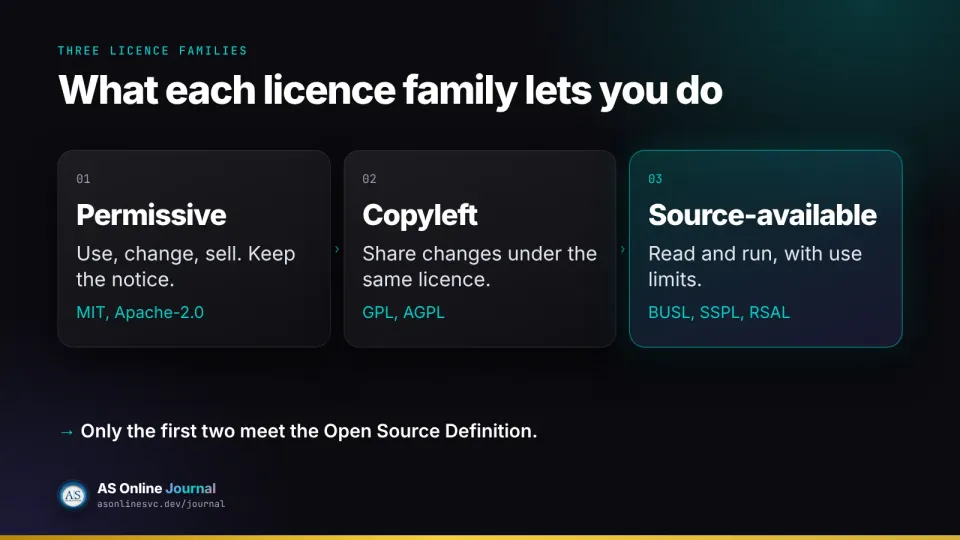
That is why licences such as the Business Source License, RSALv2 and SSPL are usually called source-available. You can read the code, often run it and change it for your own use, but some commercial uses are restricted. For most internal business use, the difference may never bite. For anyone building a product or hosted service on top, it can decide whether the plan is allowed at all.
Imagine a five-person web agency that hosts client sites. Its stack includes a Redis cache, Terraform scripts to build servers, and an Elasticsearch-based site search. Here is how the changes above land.
The point is not that any of these is forbidden. It is that each has a different answer, and none of the answers can be found by reading a headline.
The European Commission's Cyber Resilience Act page says the main obligations apply from 11 December 2027, with reporting obligations from 11 September 2026. The Commission also published practical guidance for manufacturers, developers and businesses on 27 July 2026.
For open source, the Commission's open-source page makes three points worth knowing:
If you sell a product with digital elements into the EU and it includes open-source components, the obligations fall on you as the manufacturer, whatever licence those components use.
MIT, Apache-2.0, AGPL-3.0-only or BUSL-1.1. The SPDX License List gives the standard names.The most common mistake is not a lawsuit. It is discovering a restriction late, when a product is already built on top of it. The second is overreacting: ripping out a dependency at great cost when your use was always permitted. A short written record of what you use, under which licence and how, protects you against both.
We will follow the Commission's further Cyber Resilience Act guidance as the December 2027 date approaches, and any project that changes or restores a licence. When one does, the useful question is always the same: which versions, which uses, and from when.
No. The Open Source Initiative's Open Source Definition says a licence must not discriminate against fields of endeavour, and the Business Source License restricts certain uses until the code converts to an open licence later. It is usually called source-available.
The European Commission says free and open-source software that is not monetised by its manufacturer should not be considered a commercial activity, and the Act does not apply to developers who simply contribute to projects. Projects supplied in the course of a commercial activity can be in scope. Check the Commission's open-source page for your situation.
Start with the licence files and package metadata, which often use SPDX identifiers such as MIT or Apache-2.0, then run your package manager's licence report or a software bill of materials tool, and look again whenever a dependency changes major version.
open-source licensing cyber-resilience-act software explainer