News & ExplainersNews brief
3 min readNew
Two of the most studied software failures in history came from code that worked, used in a place it was never meant for. What went wrong, what the inquiries found, and the checks every team can borrow.
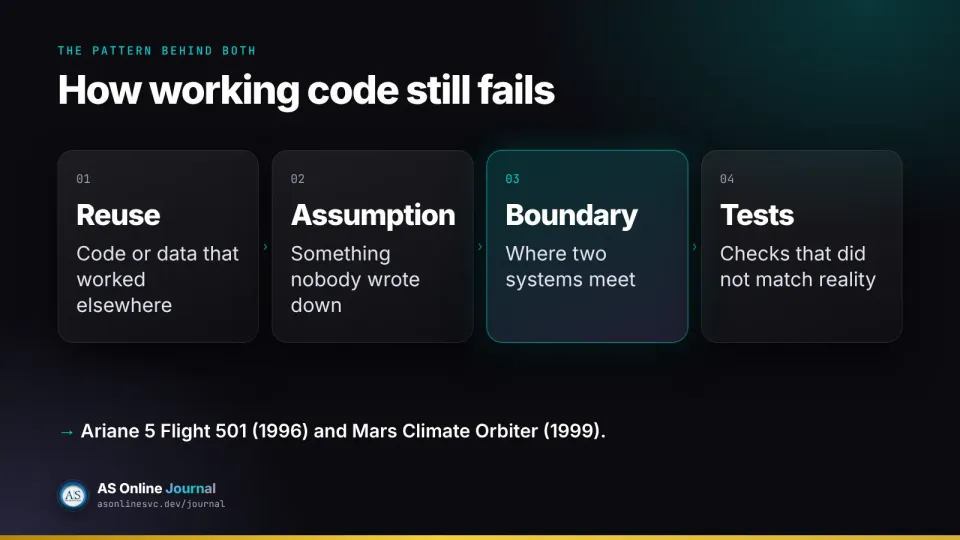
Some of the most famous failures in computing history were not caused by broken code. They were caused by working code used under assumptions nobody had checked. Ariane 5's maiden flight in 1996 and NASA's Mars Climate Orbiter in 1999 are the classic examples. Both inquiries point to the same lesson: the dangerous places are where systems meet, and the dangerous assumptions are the ones nobody wrote down.
Europe's new heavy launcher broke up shortly after lift-off on its first flight. The European Space Agency's summary of the inquiry report quotes its conclusion:
The failure of Ariane 501 was caused by the complete loss of guidance and attitude information 37 seconds after start of the main engine ignition sequence (30 seconds after lift-off). This loss of information was due to specification and design errors in the software of the inertial reference system.
Crucially, the board found that the programme's extensive reviews and tests "did not include adequate analysis and testing of the inertial reference system or of the complete flight control system, which could have detected the potential failure". ESA also notes that the equipment and system tests "were not sufficiently representative" of real flight.
The inquiry's wider account, widely studied since, is that the inertial reference software had been carried over from Ariane 4, and Ariane 5's different flight profile produced values that software had never been designed to handle.
NASA's orbiter was meant to study the Martian climate and act as a relay for other missions. NASA's mission page explains what happened: "a navigation error caused by a failure to translate English units to metric. Ground software used English units, while onboard software worked in metric." The mismatch threw off trajectory calculations and sent the spacecraft too close to Mars. Last contact was on 23 September 1999.
| Ariane 5 | Mars Climate Orbiter | |
|---|---|---|
| What was reused or shared | Inertial reference software from an earlier rocket | Navigation data passed between ground and spacecraft software |
| The hidden assumption | The new rocket's flight would behave like the old one's | Both sides used the same units |
| Where it broke | Inside a component placed in a new context | At the boundary between two systems |
| What would have caught it | Representative testing of the full system | An explicit, checked agreement on units |
Neither failure needed a genius to spot it. Each needed someone to ask, "what does this part assume, and is that still true here?"
distance_km or price_pence, or use types that carry the unit.Today's software reuses far more than it did in the 1990s: open-source libraries, cloud services, AI models and shared data. Every one of those carries assumptions from the place it was built. The specific bugs in these two cases are history. The pattern is not, which is why both still appear in engineering courses and reliability talks decades later.
Breakthroughs in computing often come from building on what already works. These two failures are the reminder that "already works" always comes with a "where" and a "when". Write those down, test them in the new setting, and the next famous failure will not be yours.
ESA's inquiry board concluded that the failure was caused by the complete loss of guidance and attitude information 37 seconds after main engine ignition, due to specification and design errors in the software of the inertial reference system.
NASA says it was a navigation error caused by a failure to translate English units to metric: ground software used English units while onboard software worked in metric, which sent the spacecraft too close to Mars.
Write down and test the assumptions behind reused code and data, including units, ranges and formats, at every point where two systems meet.
software-history software-reliability testing engineering lessons-learned