GuidesPractical guide

3 min readNew
Git 3.0 is coming with SHA-256, a new reference format and "main" as the default branch, but there is no release date. What is confirmed, what it means if you are not a developer, and the simpler tools you may already have.
Version control is no longer just for programmers. Writers, designers, researchers and small teams use it to track changes and undo mistakes. The biggest tool, Git, has published a list of confirmed changes for its next major version, Git 3.0, but there is no planned release date. If you are not a developer, the practical message is: nothing breaks tomorrow, new repositories will look slightly different one day, and the version history in the apps you already use may be all you need.
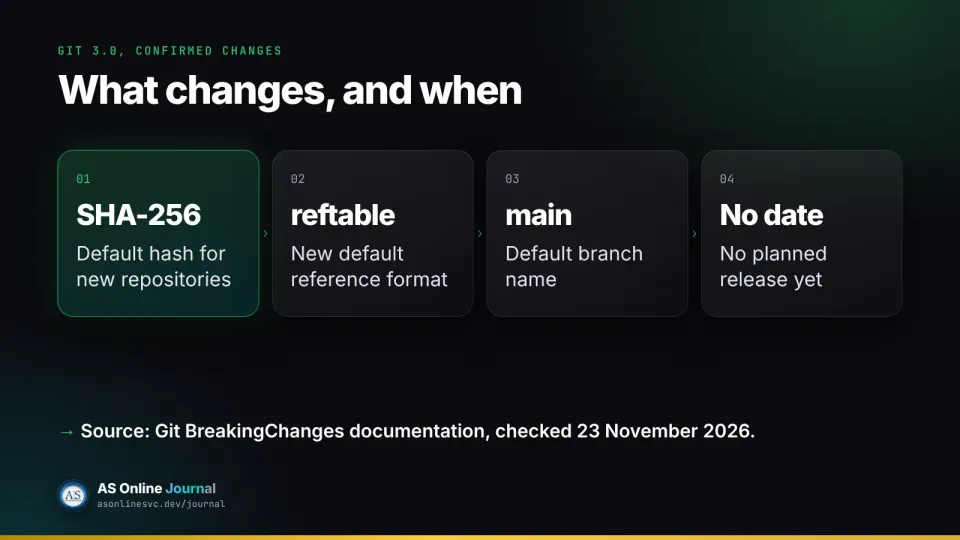
Git's BreakingChanges document lists changes the project considers ready for Git 3.0:
The document also says plainly: "There is no planned release date for this breaking version yet." Git's previous major breaking releases were Git 1.6.0 in August 2008 and Git 2.0 in May 2014.
For documents, spreadsheets and slides, you may not need Git at all. Google Docs, Sheets and Slides keep a version history you can browse and restore, as long as you have permission to edit the file. Many other office and cloud storage tools offer similar history.
| Your work | Simplest good option |
|---|---|
| Documents and spreadsheets | The app's built-in version history |
| A website, documentation or many text files | Git, with a desktop app or a hosting site's web editor |
| Large design or video files | Your design tool's or cloud storage's version history |
| Data and analysis scripts | Git for the scripts; a dated, read-only copy of the data |
| Do not assume | Why |
|---|---|
| Git 3.0 is imminent | There is no planned release date |
| You must migrate old projects | The changes are for new repositories, and SHA-1 is not being deprecated |
| Every app supports SHA-256 | Git itself says ecosystem readiness is a requirement |
| Version history is a backup | It protects against edits, not against losing your account or the whole service |
Git 3.0 is real news for developers and toolmakers, but there is no date and no need to act yet. For most non-developers, the best version control is the one built into the tools you already use, used deliberately.
Git's BreakingChanges document says there is no planned release date for this breaking version yet.
The listed changes apply to newly created repositories, such as the default hash and reference format. Git says there is no plan to deprecate the SHA-1 object format at this point. Check the tools and services you use for SHA-256 support before switching.
Often not. Google Docs, Sheets and Slides keep a version history you can browse and restore, if you have edit permission. Git helps most when many plain-text files change together, such as websites, documentation or data.