GuidesPractical guide
4 min readNew
Subject access requests can arrive by email, phone or a social media message, with no special wording. The free ICO guidance that tells a small UK business what to do, the 2026 changes, and a one-hour practice run you can do this week.
It might not look like a legal request at all. A customer replies to your invoice email: "Can you send me everything you've got on me?" A former client messages your business page asking what you kept after the job finished. Under UK data protection law, either can be a subject access request, and from the day it lands you are on a clock.
Most small businesses get one rarely, which is exactly why they go wrong. Nobody remembers the rules, the information is scattered across an inbox, a booking system and someone's phone, and the month is half gone before anyone starts. The good news is that the best guide to doing it properly is free, short and written by the regulator. Here is what it says, what changed this year, and a practice run that shows you where your gaps are before a real request does. This is general information for UK organisations, based on guidance checked on 27 November 2026, not legal advice.
The Information Commissioner's Office publishes A guide to subject access, last updated on 16 July 2026 to reflect the Data (Use and Access) Act 2025. It is the right first read because it separates what you must do (the law), what you should do (what the ICO expects) and what you could do (options). It ends with checklists, and links to a longer, detailed guide for the hard cases.
The key points, in the ICO's terms:
The Data (Use and Access) Act 2025 came in stages. The ICO's statement of 5 February 2026 says most of the remaining data protection provisions came into force that day, with the requirement to have a complaints procedure following on 19 June 2026. For subject access, three points stand out in the ICO's guidance:
The ICO's summary of the Act adds a related duty: help people who want to complain about how you use their data, for example with an electronic complaints form, acknowledge complaints within 30 days and respond without undue delay. A messy subject access response is one of the more likely triggers for a complaint, so the two belong together.
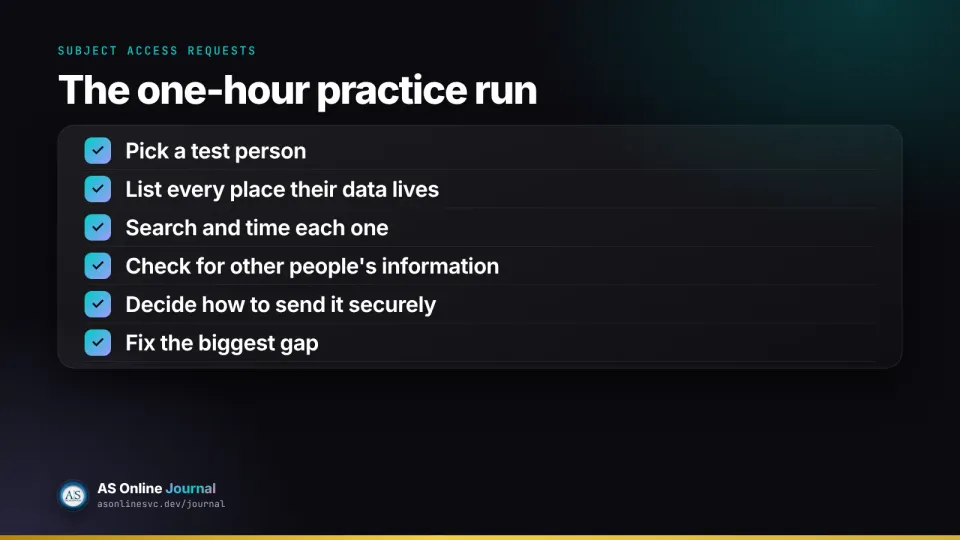
Reading the guide tells you the rules. A practice run tells you whether you can actually follow them. We think every small business should do this once, and it takes about an hour.
The brief guide is enough for straightforward requests from customers. It is not enough for requests from employees in a dispute, requests about children, or anything involving legal claims, where the ICO's detailed right of access guidance and, sometimes, professional advice are the right next step. The ICO says there are special rules for certain cases, and the guide flags them.
What we like about the regulator's approach is that it treats subject access as a service to the person, not a trap for the business: it exists so people can see how and why you use their information. Treat the practice run the same way. It is less about compliance than about knowing your own systems well enough to answer a simple question honestly.
Guidance was checked against the ICO pages listed below on 27 November 2026. It applies to UK organisations under UK data protection law. This is general information, not legal advice.
The ICO says you must respond without undue delay and within one month of receiving the request. You may extend by up to two further months if the request is complex or the person has made a number of requests. If you reasonably need to ask for ID or for clarification, the ICO explains when the clock waits for the reply.
In most cases, no. The ICO says you can charge a reasonable fee for administrative costs only if the request is manifestly unfounded or excessive, or if the person asks for further copies.
The ICO says you must make a reasonable and proportionate search, and do not need to carry out searches that are unreasonable or disproportionate to the importance of the information. This was made explicit by the Data (Use and Access) Act 2025. It is not a licence to skip obvious places, such as your inbox or customer system.
No. This is general information based on the ICO's guidance as it stood on 27 November 2026, for UK organisations. If a request is complicated, involves other people's information or a dispute, read the ICO's detailed guidance or take advice.
data-protection uk-gdpr subject-access-request small-business ico