News & ExplainersExplained

5 min readNew
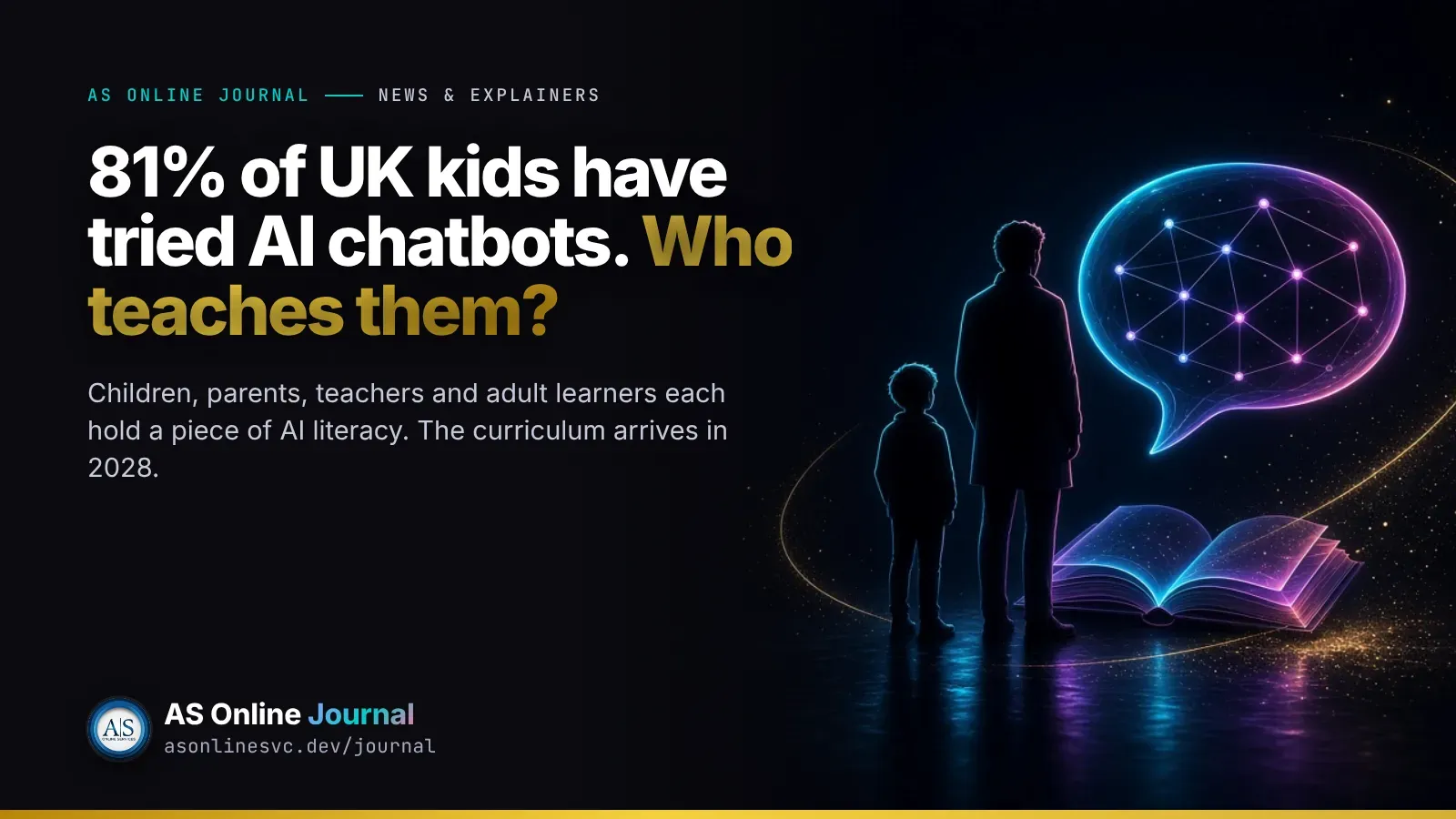
Who teaches whom? Children, parents, teachers and adult learners each hold a different piece of AI literacy, and nobody can wait for the syllabus.
On 24 November, Ofcom published a number that most parents had already felt in their own kitchens. 81% of UK children aged 8 to 17 have used an AI chatbot in the past six months. For UK adults the figure is 64%. Of the children who use them, 35% do so every day, and 53% use them for schoolwork or homework.
Now the other date. England's reformed curriculum, which the government says will teach pupils AI literacy, how computers are trained on data and how bias creeps into technology, is for first teaching from September 2028. Until then, the government's own line is that pupils pick up the foundations through computing and maths, and that the National Centre for Computing Education offers teachers free online courses.
That leaves roughly two school years where the tool is already in most children's hands and the syllabus is not. So who teaches whom? Not in a neat line from expert to child. In a loop, and every person in it has something to give and something to learn.
(One note on scope: education is devolved. The Department for Education's material is about England. Scotland, Wales and Northern Ireland run their own systems, and this piece does not try to cover them.)
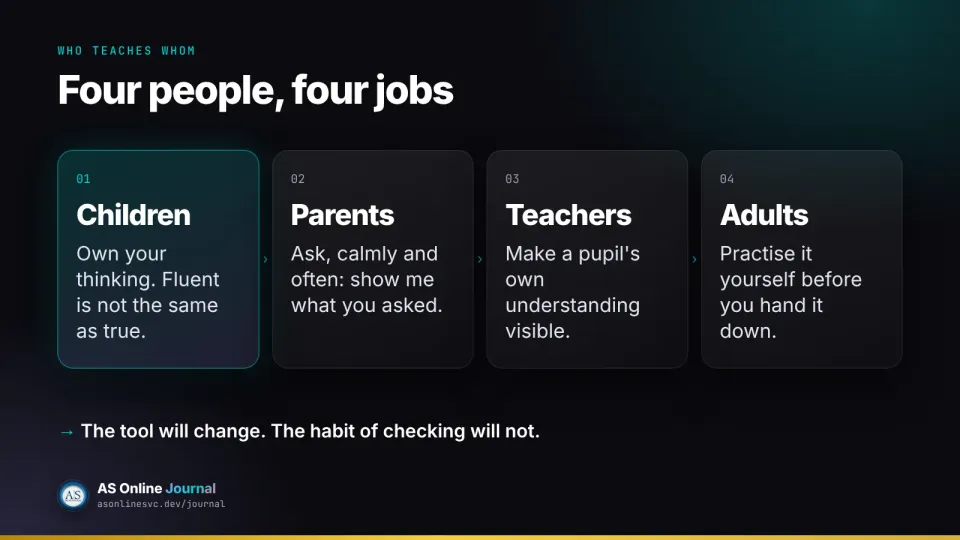
The headline skill is not "prompting". Prompts change every few months. The durable skill is knowing what a chatbot is doing when it sounds sure of itself.
The Department for Education spells out the risks plainly: output can be inaccurate, biased, out of date, or "nonsensical, inaccurate or false information presented as fact". It can also produce believable scam emails. A child who has absorbed that one idea, that fluent does not mean true, is better equipped than one who has memorised ten prompt tricks.
The second job is about honesty with school work. For GCSE, A level and other qualifications, the Joint Council for Qualifications (JCQ) says work must be the student's own, any AI use must be acknowledged, and unacknowledged use that leaves the work not really theirs counts as malpractice. Its guidance was revised on 20 November 2026, six days ago. For a teenager this is not a moral lecture. It is the rule that decides whether coursework counts.
Ofcom's parent figures are interesting because they are self-reported. Of parents whose child uses chatbots, 76% say they feel confident they know what the child uses them for, and 68% of all parents say they understand how chatbots work. Those are what parents told a survey, not tested knowledge, and the survey cannot say whether the confidence is deserved.
What parents also said is the more useful part. Around half (49%) worry their children may become lazy or outsource answers and thinking to chatbots, and almost four in ten (38%) fear they will not learn properly if they rely on AI. Ofcom also found that 9% of child users have turned to a chatbot for company or someone to talk to, and that 35% of teenagers aged 13 to 17 who use chatbots have taken part in roleplay with one.
A parent's role here is not to out-technologise a teenager. It is to be the person who asks, calmly and often, "show me what you asked it, and what did you do with the answer?" The questions work even if you have never opened a chatbot.
The DfE says it sees "more immediate benefits and fewer risks" from teacher-facing use of generative AI, such as planning, resources and feedback, than from pupil-facing use, and that evidence on the effect on learners is still limited. Schools that do put pupil-facing tools in front of children must take "great care" over data protection, safeguarding and intellectual property.
For the classroom, the JCQ guidance pushes in one clear direction: set and assess work so that a student's own understanding can be shown. It also tells teachers they must not use AI as the sole or primary means of marking candidates' work, because the teacher remains responsible for the mark. That is a clean statement of who is accountable. The tool can assist. A person signs.
If children are ahead on usage, adults are not ahead on confidence. DSIT research published with the January 2026 AI Skills Boost announcement found that only 21% of UK workers feel confident using AI at work.
The government's answer is free: every UK adult is eligible for short AI foundations courses on the AI Skills Hub, some taking under 20 minutes. Two things are worth knowing before you click. The courses are made by industry partners, including big technology firms, and then checked against Skills England's benchmark, which covers understanding the risks and consequences of using AI, writing prompts, and automating routine tasks. So treat them as a sound starting point, not the last word, and keep your own judgement switched on.
Adults are also using these tools for more than spreadsheets. Ofcom found that 25% of adult chatbot users have used one to look up medical advice, and 12% for relationship or personal advice. A chatbot is not a doctor or a friend, and an adult who models that distinction teaches it faster than any worksheet.
The independent Curriculum and Assessment Review, whose final report came out in November 2025, makes a point that suits this whole subject. It says it uses "digital literacy" rather than "digital skills" because literacy includes knowledge as well as skills, and "with rapid technological change, skills alone can date quickly". What lasts is understanding how systems work.
That is the idea worth selling to a ten-year-old and a fifty-year-old alike. Today's chatbot will be replaced. The habit of asking how does this thing arrive at what it tells me, and what would I check? will not be.
A child's first phone is a natural moment to talk about the rules, AI included. Our own First Phone Family Agreement (£5) is a fill-in agreement to talk through before a child's first phone: what it is for, privacy, spending, what to do when something goes wrong, and when you will review the rules. It includes conversation starters, and it notes that Internet Matters lists how AI chatbots work, and why they are not a substitute for a trusted adult, among the topics worth raising early and often. It is not an AI course and does not teach AI literacy. It is a conversation starter, not legal or safeguarding advice, and Childnet publishes a free one-page family agreement if you would rather start there. See the First Phone Family Agreement on Gumroad.
Evidence on whether pupils benefit from using generative AI is still emerging, and the DfE says as much. Ofcom's figures come from one survey of 2,004 children and their parents in August and September 2026. Neither tells us what happens to a child's learning five years from now. What both tell us is that the question is already in the house.
For other family digital habits, see our seven questions to ask before your family shares a password manager.
In England, pupils are expected to pick up the foundations through computing and maths. The government says the reformed curriculum will teach AI literacy, how computers are trained on data and bias in technology, with full implementation for first teaching from September 2028. Education is devolved, so Scotland, Wales and Northern Ireland make their own arrangements, which this article does not cover.
Ofcom's survey, published on 24 November 2026, found that 81% of 8 to 17-year-olds had used an AI chatbot in the previous six months, compared with 64% of UK adults. Of the children who use them, 35% do so daily and 53% use them for schoolwork or homework.
Only as the rules allow. The Joint Council for Qualifications says work submitted for assessment must be the student's own, that any use of AI must be acknowledged, and that unacknowledged use that means the work is not their own is malpractice. Ask your child's school what its own policy is for each subject.
Yes. The government's AI Skills Boost programme offers free online AI foundations courses that every UK adult can take, some in under 20 minutes. The courses are made by industry partners and checked against a Skills England benchmark.
ai-education ai-literacy children parents schools uk explainer