News & ExplainersNews brief
5 min readNew
An intruder used a hijacked employee GitHub account to reach 1Password's backend and copy account records. The vaults were not touched, but the stolen list is a ready-made phishing target.
On 25 November 2026, 1Password published a disclosure saying an attacker got into some of its backend systems and copied account records for a subset of its customers. The records include the names and email addresses people use to sign in. 1Password says customer vaults, the items inside them and the keys that protect them were not affected, and that customers do not need to change anything. The practical risk is not your stored passwords. It is the convincing "1Password" emails that criminals can now send to a list of people who really do use it.
According to 1Password's disclosure, it began investigating on 19 November 2026 after seeing signs that an attacker had gained access to an employee's corporate GitHub account. The attacker used that account to reach source code and to push malicious code to backend services, which then downloaded administrative data about customers.
Everything below about what was taken and what was fixed comes from 1Password itself. BleepingComputer, The Verge and TechCrunch report the same account, and we have not found independent confirmation of the details beyond the company's statement.
Account records for a subset of users, including:
The attacker also copied source code from private repositories and reached the company's CI/CD system, which holds infrastructure secrets the product needs to run. 1Password says it has rotated or revoked all credentials that may have been exposed.
Vault contents, the keys that protect vaults, account recovery keys, and the apps and browser extensions. The company says it does not store your account password or Secret Key, so it could not have lost them. It says its services are working normally.
The most technical part of the disclosure is about tokens in emailed links. When 1Password emails someone an invitation to join an account, or a link to recover one, the link carries a token. 1Password says a token on its own cannot get into an account: finishing the process needs either a single sign-on login or a six-digit code sent to the user's registered email address. As a precaution it has lengthened that code from six digits to ten letters and numbers, which it says makes guessing "practically impossible". It also says a small number of users who were midway through such a process at the time were notified directly, and that it found no internal evidence of account takeovers using the exposed tokens.
That is the company's assessment. It is a reasonable step, and it is worth remembering that an independent check has not been published. 1Password says it has brought in outside cybersecurity experts to validate its containment and remediation.
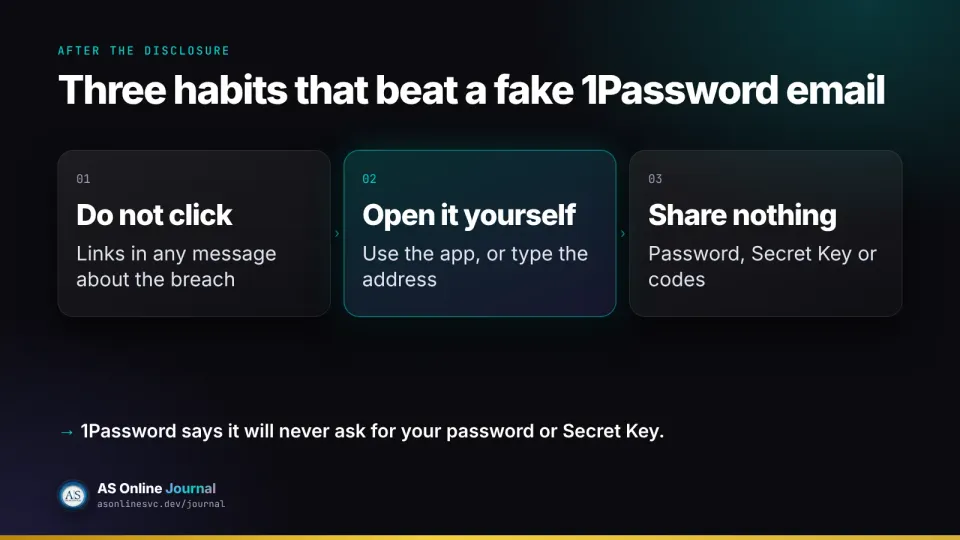
1Password's own advice is short: you do not need to update anything, and you should be cautious about unexpected emails, texts or calls that mention 1Password, invitations or account recovery. It says it will never ask you for your account password or Secret Key, and that you should enter them only in the official app or on its website, reached by opening the app or typing the address yourself.
BleepingComputer points out why that matters: a list of known 1Password users is valuable to criminals who want to send emails impersonating the company, perhaps claiming you must "secure your account" because of the breach.
If you want to report a suspicious email in the UK, forward it to the National Cyber Security Centre at report@phishing.gov.uk.
Not on this evidence. What 1Password describes is a company-side compromise that, on its account, never reached the encrypted vaults. The design held: it says it could not hand over passwords it does not keep. The real exposure is a mailing list. That is a reminder that a password manager protects your passwords, not your email address, and that no provider can stop a criminal from writing to you. If you are weighing up which to use, our guide to questions to ask about password managers for families covers what to look for.
Facts in this article were checked against the sources listed below on 26 November 2026. This is a developing story: 1Password says it will keep customers informed, and details such as the number affected may change.
1Password says no. Its disclosure says vault contents, the items in them and the keys that protect them were not accessed, and that it does not store your account password or Secret Key. The Verge, TechCrunch and BleepingComputer all report the same account of the incident, but all rely on 1Password's own statement.
Account records for a subset of customers. 1Password lists names and sign-in email addresses, account and user identifiers, account creation and last sign-in times, public keys, Secure Remote Password protocol parameters, tokens in some emailed invitation, provisioning and recovery links, and other non-secret metadata. The attacker also copied source code and reached its CI/CD system.
1Password says you do not need to update anything in your account. It does recommend caution with unexpected emails, texts or calls that mention 1Password, invitations or account recovery. If you want to change a password anyway, it does no harm, but it is not what the company asks of customers.
Not stated. The Verge and TechCrunch both note that 1Password has not said how many customers had records copied. 1Password says only that it was a subset, and that a small number of users who had an invitation or recovery in progress were notified directly.