News & ExplainersExplained

5 min readNew
Hidden fees, crossed-out prices and countdown clocks are all covered by consumer law, but the rules on 'was' prices are less clear than most shoppers assume. Here is what is settled, what is not, and a short checklist.
Black Friday is the busiest week for discount claims, and UK law already covers some of them: hiding unavoidable charges until late in checkout is illegal, and so is falsely claiming an offer will end soon to rush you. The less settled area is the "was £120, now £79" price. Misleading comparisons can already be unlawful, but proving it is hard, and in August 2026 the government said it would consult on banning the worst tactics outright. Until then, the most reliable protection is a few checks you make yourself. This is general information from published guidance, not legal advice.
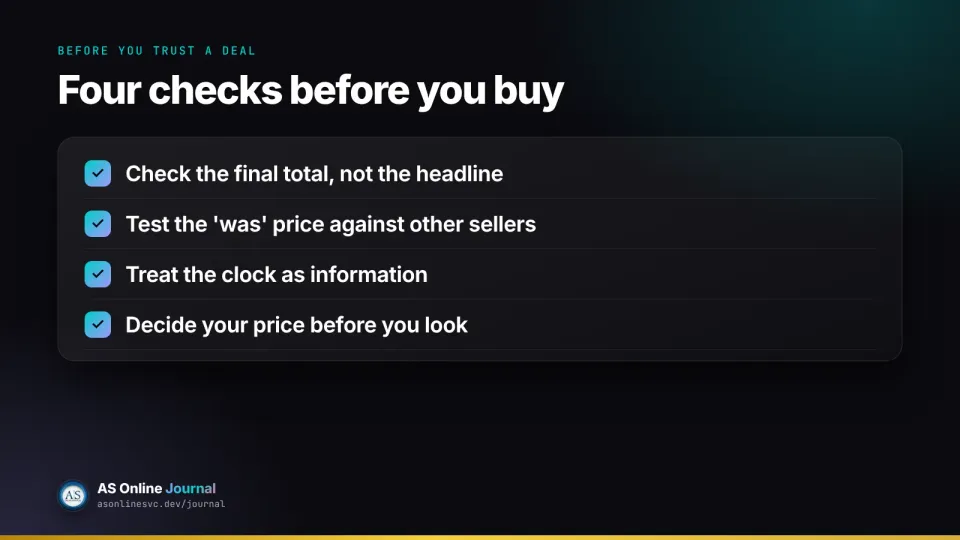
The Competition and Markets Authority (CMA) summarises its price guidance like this: traders must give total prices up front, and it is illegal to hide additional fees, taxes or other charges the customer will have to pay until later in the purchase process. That practice is called drip pricing. The guidance says the total price should normally include unavoidable charges such as VAT and mandatory delivery charges. Optional extras, such as paying more for next-day delivery, can be shown separately.
So if a headline price grows at the last step because of a charge you could not avoid, that is the practice the CMA says is prohibited. Businesses that break the law, it says, can be fined up to 10% of turnover or £300,000, whichever is greater, and ordered to compensate customers.
The CMA's unfair commercial practices guidance lists practices that are unfair in all circumstances. One is falsely stating that a product will only be available for a limited time, in order to prompt an immediate decision. Its example is a trader who falsely tells a shopper that an offer will end when a countdown clock runs out. The key word is falsely: a genuine deadline is allowed.
The same guidance covers misleading actions, including a presentation that deceives the average shopper even when each fact is technically true. Its example is a television advertised as heavily discounted, with a tiny footnote saying the offer applies to very few sets, for a short time, in one shop.
This is where shoppers often assume more protection than exists. According to a Guardian explainer in September 2026, the 2024 consumer law already prohibits misleading actions, so deceptive pricing tactics are often already illegal, but for a case to succeed the regulator must show that a misleading price actually affected a shopper's choice, which is not always easy. The article says old government guidance asked retailers to sell at a higher reference price for 28 consecutive days, but that the current law sets no fixed period. It cites Chartered Trading Standards Institute guidance, which is not legally binding, saying a quoted saving must be genuine and that selling at the higher price for a shorter time than the discounted one would be bad practice.
On 9 August 2026 the government announced that a consultation would launch in autumn to assess whether fake "was" prices, invented discounts and misleading recommended retail prices should be added to the list of banned practices. We could not find the consultation on GOV.UK when we looked on 26 November 2026, so we cannot say whether it has opened, what it proposes, or when any change might take effect. If it does become law, it would not be in time for this Black Friday.
The Guardian also reports research by Which? from late 2025 that looked at 175 Black Friday offers from eight retailers and found that the vast majority were cheaper than, or the same price as, at other times of the year. That is one study of a sample of offers, not proof about every deal, but it is a reason to check.
The guidance above is aimed at traders, so it will not walk you through a complaint. Start with the seller, and keep screenshots of the advert, the price and the checkout. If you are not satisfied, Citizens Advice can explain your options. For a suspicious shop rather than a dodgy discount, see our 60-second check before you pay.
The government's August announcement also said new rules on subscription traps would come into force in January 2027, including clearer information up front and an easier exit. We have not looked at the detail here. The point for shoppers is that pricing rules are changing, so what holds today may not hold next year.
Facts in this article were checked against the sources listed below on 26 November 2026. This is general information, not legal advice, and the law and any consultation may change.
The CMA's guidance says it is illegal to hide additional fees, taxes or other charges the customer will have to pay until later in the purchase process, sometimes called drip pricing. Unavoidable charges, including mandatory delivery charges, should normally be in the total price shown up front. Optional extras such as next-day delivery can be shown separately.
It can be, but not automatically. A misleading price comparison can already break the law if it is likely to change what the average shopper decides. In August 2026 the government said it would consult on adding fake 'was' prices, invented discounts and misleading recommended retail prices to the list of practices banned outright. We could not find that consultation on GOV.UK when we checked on 26 November 2026.
Yes. The banned practice is falsely stating that a product will only be available for a limited time to push you into an immediate decision. A countdown that reflects a genuine deadline is not the problem.
No. It is a plain-English summary of published guidance, checked on 26 November 2026. If you believe you were misled, Citizens Advice and Trading Standards are the places to start.