News & ExplainersExplained

5 min readNew

The reason to move is a threat that may be years or decades away. The consequences of moving are already here: supply-chain dependence, heavier hybrid systems, standards still in flux, and a migration that mostly lands on vendors.
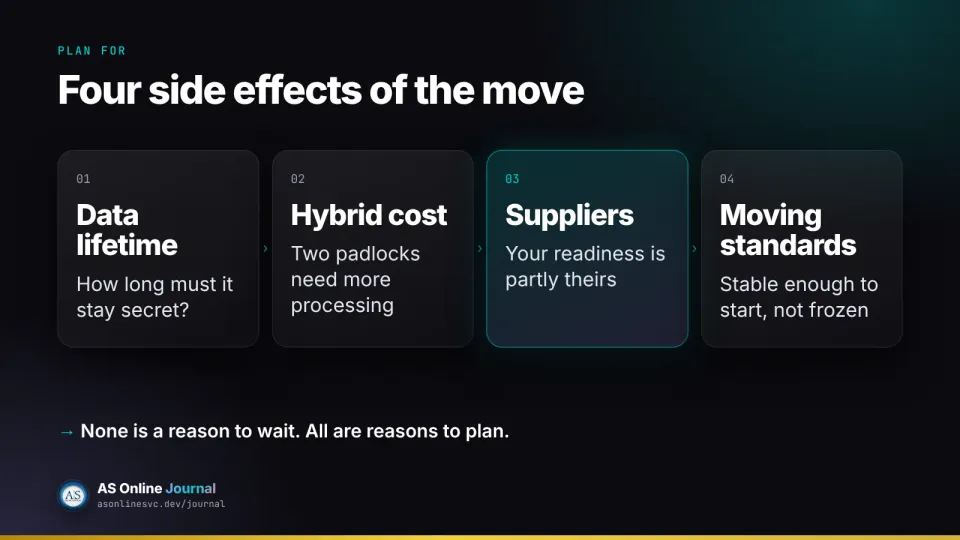
Governments have set dates, mostly around 2035, for moving to cryptography that a future quantum computer could not break. The case for starting is strong, and this article does not argue against it. But a change of this size has side effects, and some of them are visible already. The guidance from the UK's National Cyber Security Centre (NCSC) and the US National Institute of Standards and Technology (NIST) points to four: the urgency comes from data that is being collected now, hybrid designs cost more computing power, most of the work depends on suppliers, and parts of the standards are still unfinished. None of these is a reason to wait. They are reasons to plan.
The NCSC says quantum computers will be able to efficiently solve the hard mathematical problems that today's public-key cryptography relies on, and that the main defence is migrating to post-quantum cryptography (PQC), which uses problems quantum computers cannot solve efficiently. NIST's project page describes such machines as "years or decades away", but NIST's October 2026 report announcement explains why that is not a reason to wait: data encrypted today is already at risk from "harvest now, decrypt later", where adversaries collect sensitive data now to decrypt it when the technology matures.
The NCSC's indicative milestones are: by 2028, define goals, complete a discovery exercise and build an initial plan; by 2031, carry out the highest-priority migration activities; by 2035, complete migration of all systems, services and products. NIST says it will deprecate and ultimately remove quantum-vulnerable algorithms from its standards by 2035, with high-risk systems moving much earlier. Both sets of dates are guidance for organisations, not a deadline for individuals.
Because the threat is about collection now and decryption later, the risk is not the same for everything. NIST's own example is that organisations might prioritise moving key establishment (FIPS 203) for data that is particularly sensitive or needs to stay secure for a long time. A message that is worthless in a week is a different case from a medical record or a trade secret. The consequence is that a single national date hides very different local deadlines, and an organisation that has not worked out how long its data must stay confidential cannot tell which one applies to it.
NIST's report discusses a hybrid approach, combining conventional encryption with PQC, which it compares to using two padlocks on a door. It says this is more conservative from a security standpoint but demands more computational resources. That is a trade-off, not a flaw, but it means the extra protection is paid for in processing, and the cost lands hardest where devices are small or busy. NIST says it accommodates the hybrid option, and does not say that everyone should use it.
NIST says the cryptographic supply chain matters as much as an organisation's own components, and that cybersecurity products, services and protocols will need updates. The NCSC's guidance is aimed mainly at technical decision-makers and risk owners at large organisations, critical national infrastructure operators and companies with bespoke IT. For everyone else, which includes most households and small businesses, the migration will mostly arrive through updates from suppliers: operating systems, browsers, routers, cloud services. We have not found official consumer-specific guidance, so that is our reading. The consequence is that your readiness is partly decided by whether your suppliers are ready and still supported, which makes unsupported devices a quiet weak point.
NIST published its three principal PQC standards, FIPS 203, 204 and 205, in August 2024, and says they can and should be put into use now. It also says the Falcon signature algorithm and the HQC key-encapsulation mechanism were selected for ongoing standardisation, and that this process is under way. The NCSC adds that a small set of more rarely used technologies may find migration by 2035 harder. The consequence for planners is that the target is stable enough to start but not frozen, which is why NIST's own project highlights cryptographic agility: designing systems so an algorithm can be swapped without rebuilding everything.
There is a reasonable case for moving more slowly: quantum computers that can break today's encryption do not exist yet, hybrid designs cost resources, and standards are still being completed. The answer from both agencies is that the migration is long, that sensitive data is already being collected, and that, in the NCSC's words, most of the work involves activities central to good cyber security practice anyway, such as knowing what cryptography you depend on. Starting with discovery costs relatively little and does not lock you into any algorithm.
We have not found evidence either way on this, so treat it as a question rather than a finding. When a change is this large and deadlines are public, "quantum-safe" is an easy phrase to put on a product page. A fair test is to ask a supplier which standard they use, whether it is hybrid, what they have not yet migrated, and how they will update it.
Facts in this article were checked against the sources listed below on 26 November 2026. Dates and standards may change, so check NCSC and NIST for the latest.
No. NIST describes quantum computers as machines that may be years or decades away from being able to break many of today's widely used systems. The concern is that data collected now could be decrypted later, which NIST calls 'harvest now, decrypt later'.
The NCSC's guidance sets indicative milestones: by 2028 define goals, complete a discovery exercise and build an initial plan; by 2031 carry out the highest-priority migration activities and refine the plan; by 2035 complete migration of all systems, services and products. It is aimed mainly at large organisations, operators of critical national infrastructure and companies with bespoke IT.
The NCSC's timelines are aimed at larger organisations. For most people and small businesses, the practical step is to keep devices, browsers and services updated, since the migration will mostly arrive through supplier updates. We have not found official consumer-specific guidance, so this is our reading.
NIST accommodates a hybrid approach, combining conventional and post-quantum methods, and says it is more conservative from a security standpoint but demands more computational resources.