AI ToolsPractical guide

7 min read
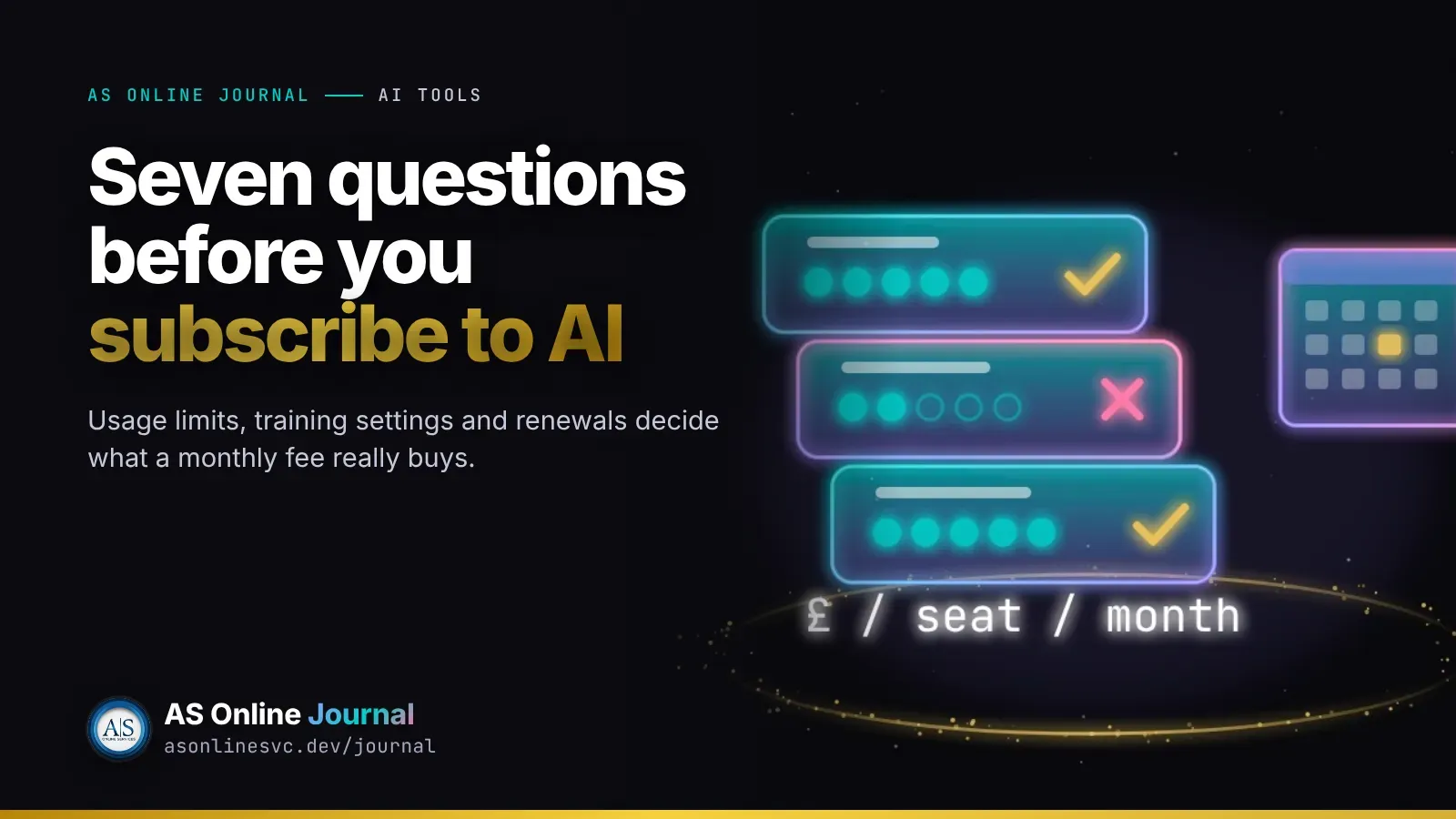
Usage limits, training settings and renewal terms all change what a monthly fee actually buys. Seven questions that work whichever AI service you are looking at.
An AI subscription looks simple: a monthly fee for a better chatbot. In practice the fee buys a bundle of things that can change after you sign up: a usage allowance, access to particular models, and a set of privacy defaults. Before you start one, or keep paying for one into the new year, seven questions are worth asking. They do not tell you which service to choose. They tell you what you are actually agreeing to. The examples below use OpenAI's ChatGPT because it is in the news this week and its help pages are public, not because it is the only service worth asking about.
Most plans sell a usage allowance, not unlimited use. On 25 November 2026 TechCrunch reported that, under OpenAI's new system, Chat and Work will share a single usage meter across ChatGPT, while conversations with its Instant model remain unlimited and do not count towards the allowance. So the allowance may cover only some models. Find out which models and features your plan counts, and which it does not.
The same report is a live example. Some subscribers said merging the limits could leave them with less access to advanced reasoning models while paying the same fees. An OpenAI spokesperson told TechCrunch that most users are not expected to face more frequent usage resets, but a small fraction of its heaviest users may hit their limits sooner, and that shared limits are due to roll out more broadly in December per its support page. We cannot say how that will work out for any individual. The lesson is general: check the plan's terms for how the provider may change it, and note what you use today so you can tell whether it has changed.
It depends on the service and the plan. OpenAI's data controls page says that on personal ChatGPT Free, Plus and Pro workspaces, sharing data to improve the model is on by default, and you can turn off "Improve the model for everyone" and keep your chat history. It says Business, Enterprise and Edu workspaces are not used to train its models by default. Three details from that page are easy to miss:
Other providers have their own settings and defaults, which we have not compared here. Look for the equivalent page before you put anything private in.
Know the renewal date, the price after any trial, and where the cancel button is. The government has published guidance on new subscription rules under the Digital Markets, Competition and Consumers Act 2024. The draft regulations, laid in Parliament on 19 October 2026, are due to come into force on 1 January 2027. According to a law firm's summary of the draft guidance, they include reminder notices before renewal and two 14-day cooling-off periods: one after signing up, and one when a trial ends or a contract renews for 12 months or more.
Probably not, and this is the question most people will not think to ask. The same summary says the rules apply only to subscription contracts entered into on or after 1 January 2027, and that an existing contract does not become subject to them just because it auto-renews after that date. The draft regulations say the same. That is our reading of the published material: a plan you start in December, or one you already have, would be under the existing rules. The government nevertheless describes consistent protections for all consumers as best practice, according to the same summary, so some providers may apply them early. Do not count on it. Check the regulations' final status on GOV.UK, since the instrument was a draft when we checked.
Families can end up with two or three paid plans for the same kind of tool. Before adding one, ask whether an existing plan has a family or shared option, and whether the people who would use it need their own allowance. If you are buying one as a gift, remember that the person receiving it will have their own privacy settings to check.
The most useful test is also the simplest. For a month, jot down each time you use the tool and what it saved you. If you cannot name a task, or you hit the free tier's limit only once, the subscription is a candidate to cancel. If you do rely on it, you have a reason to keep it and a baseline for judging changes to the plan.
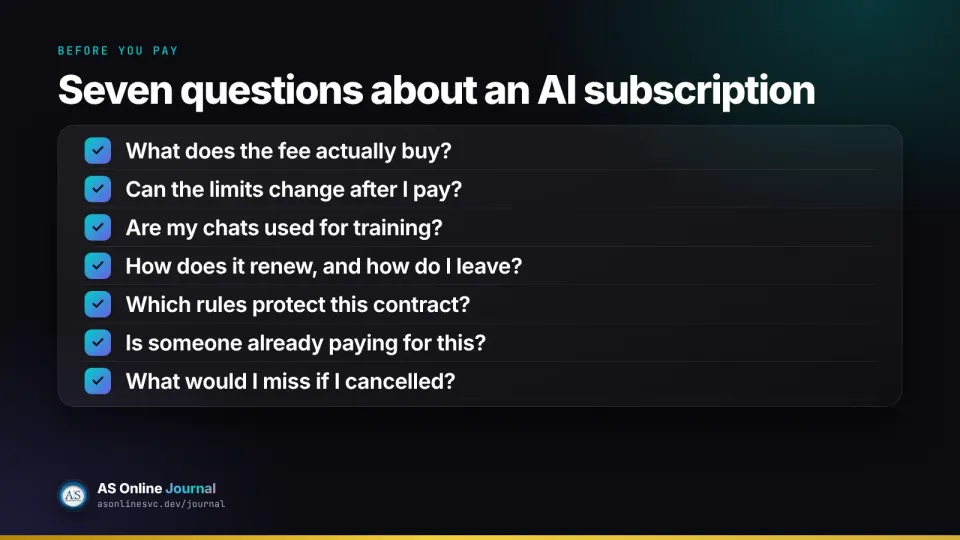
We have not tested any AI service and are not recommending one. We used OpenAI's pages for the privacy and usage examples because they are public and current; they are not a statement that other providers are better or worse. Prices and plans change often, so check the provider's own pages on the day you decide.
Facts in this article were checked against the sources listed below on 26 November 2026. The subscription regulations were in draft when we checked, so confirm their final status before relying on dates.
It depends on the service and the plan. OpenAI's help page says that on personal ChatGPT Free, Plus and Pro workspaces, data sharing for model improvement is on by default and can be turned off in Data controls, while Business, Enterprise and Edu workspaces are not used for training by default. Other providers have their own settings, so check each one.
Providers do change plans. On 25 November 2026 TechCrunch reported that OpenAI is merging Chat and Work in ChatGPT with a single shared usage meter, and that some subscribers worried it could reduce their access to advanced models at the same price. OpenAI told TechCrunch most users are not expected to see more frequent resets, but a small fraction of its heaviest users may hit limits sooner. Read the terms for your own plan.
Based on the published draft regulations and legal commentary, the new rules apply only to subscription contracts entered into on or after 1 January 2027, so a December sign-up would fall under the existing rules. The regulations were laid in draft on 19 October 2026, so check GOV.UK for their final status.
No. It is a plain-English summary of published sources, checked on 26 November 2026. It does not recommend any particular AI service.