GuidesPractical guide

6 min readNew
Generated clips are cheap to make and costly to get wrong. A free worksheet for small businesses and creators choosing between AI video and a stock library, built from YouTube's disclosure rules, a real stock licence and the UK government's own copyright report.
A ten-second clip of a coffee cup steaming on a sunny windowsill used to mean a stock library search, a licence fee and a compromise on the exact cup. Now you can type the sentence and get the clip. That is a real change for anyone making videos for a small business, a course or a channel, and it is tempting to treat it as a straight swap.
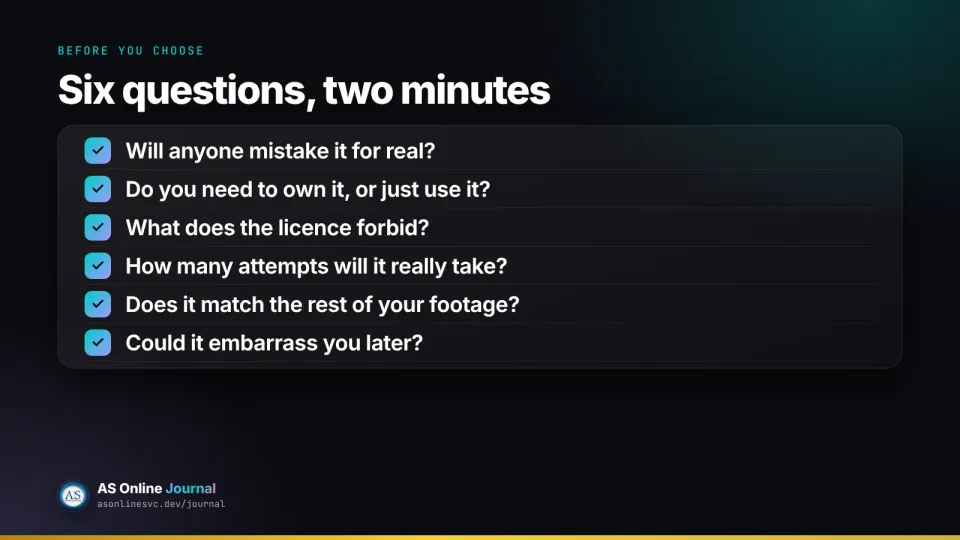
It isn't. A generated clip comes with questions a stock clip mostly answers for you: whether you have to tell viewers, who owns it, and what happens when the fourth attempt still has a hand with six fingers. A stock clip has its own small print. The right choice depends on what the footage is for, so here are six questions to settle first. Our sources were checked on 27 November 2026, and none of this is legal advice.
This is the question that decides most of the others. YouTube's disclosure rules require creators to disclose AI-generated or altered content "that seems realistic". YouTube lists what must be disclosed: making a real person appear to say or do something they did not, altering footage of a real event or place, generating a realistic scene that did not happen, and AI music that is the main focus of the video. It says non-realistic content, such as someone riding a unicorn, and minor edits, such as colour correction or background blur, do not need a label.
So a stylised animated intro is low risk. A realistic shot of "our workshop" that is not your workshop is a different thing, and it is the kind of clip that can mislead a customer even where no platform rule applies. The UK government's March 2026 report on copyright and AI notes there are no UK obligations to label AI-generated content, and says it will work with industry on best practice. No legal duty is not the same as no reputational cost.
For a social post, using a clip is usually enough. For a product, a course you sell or a brand film you want to stop others copying, ownership matters, and here AI footage is murky.
UK copyright law has a special rule for computer-generated works. Section 9(3) of the Copyright, Designs and Patents Act says that for a computer-generated literary, dramatic, musical or artistic work, the author is the person who made "the arrangements necessary for the creation of the work". The government's own report says there "appears to be a legal contradiction" in that rule, because originality is tied to human creative choices, and it discusses removing the protection for wholly computer-generated works. It also notes that a film recording generated by an AI system is protected in a similar way to a recording of birdsong. That is thin protection for anything you want to call yours.
A stock clip, by contrast, is someone else's work that you are licensed to use. You won't own it either, but you know exactly where you stand.
Free does not mean unconditional. Take Pexels, a popular free library. It says its videos are free to use, can be modified, and do not need attribution. It also says identifiable people must not be shown "in a bad light or in a way that is offensive", that you must not imply people or brands in the footage endorse your product, and that you must not resell unaltered copies or use the footage as part of a trade mark.
Paid libraries and AI video services each have their own terms, which we have not reviewed here. Read the one you are about to use, and look for three things: whether commercial use is allowed, what it says about recognisable people and logos, and whether you can use the clip in something you sell.
This is the cost nobody puts on the pricing page. A stock search is predictable: you find the clip or you don't, and you can see it before you pay. Generation is a slot machine with a style guide. You might get the shot first time. You might spend an afternoon, and whatever credits your plan includes, chasing consistent hands, readable text or the same person across two shots.
We have not tested any AI video tool for this guide, so we won't put numbers on it. Our suggestion is to budget for it honestly: set a limit on attempts before you start, and if you hit it, go to stock. Treat the first generated clip that works as a bonus, not the plan.
A single generated cutaway inside a video shot on your phone can look like a postcard taped into a family album. Lighting, grain, lens and colour all give it away. Stock has the same problem in a milder form, because good libraries offer series shot in one session.
If the clip has to sit between two real shots, test it in the edit before you commit, at the size people will watch it, which is usually a phone.
Run one last test: if a customer found out exactly how this clip was made, would they feel misled? A generated aerial view behind a title card, probably not. A generated "happy customer", or a realistic product shot of something that does not look like what you ship, almost certainly yes, and that is also where advertising rules on misleading claims start to matter. When in doubt, use real footage of the real thing, or label it.
AI video is genuinely useful for the clips that were never meant to be real: abstract backgrounds, stylised explainers, mood shots behind text. For anything that stands in for your product, your place or your people, stock footage or your own camera is still the safer bet, because it answers the ownership and honesty questions before you ask them. The worst choice is the default one, made because generation felt free.
Keep the six questions somewhere visible. They take two minutes, and they are cheaper than remaking a video after it has gone out.
Sources were checked on 27 November 2026. Platform rules, licences and UK copyright policy change; check the current versions before you rely on them. This is general information, not legal advice.
Sometimes. YouTube's help centre says creators must disclose AI-generated or altered content that seems realistic, such as content that makes a real person appear to say something they did not, alters footage of a real event or place, or generates a realistic scene that did not happen. Non-realistic content and minor edits such as colour correction or beauty filters do not need disclosing.
It is unsettled. The UK government's March 2026 report on copyright and AI says the special rule for computer-generated works in section 9(3) of the Copyright, Designs and Patents Act contains a legal contradiction that makes it uncertain, and it notes that a recording of film generated by an AI system is protected in the way a recording of birdsong is. This is not legal advice; if ownership matters to your business, take advice.
No. Pexels, for example, says its videos are free to use and modify without attribution, but you must not show identifiable people in a bad light, imply that people or brands in the footage endorse your product, or resell unaltered copies. Every library has its own licence, so read the one you use.
No. This guide has no affiliate or product links, and we have not tested any AI video tool for it.
ai-video stock-footage video-editing copyright small-business