Web & HostingExplained

3 min readNew

Data centres use about 1.5% of the world's electricity, and AI could double that by 2030. The global share is small; the local effects are not. Who carries the cost, and what website owners can do.
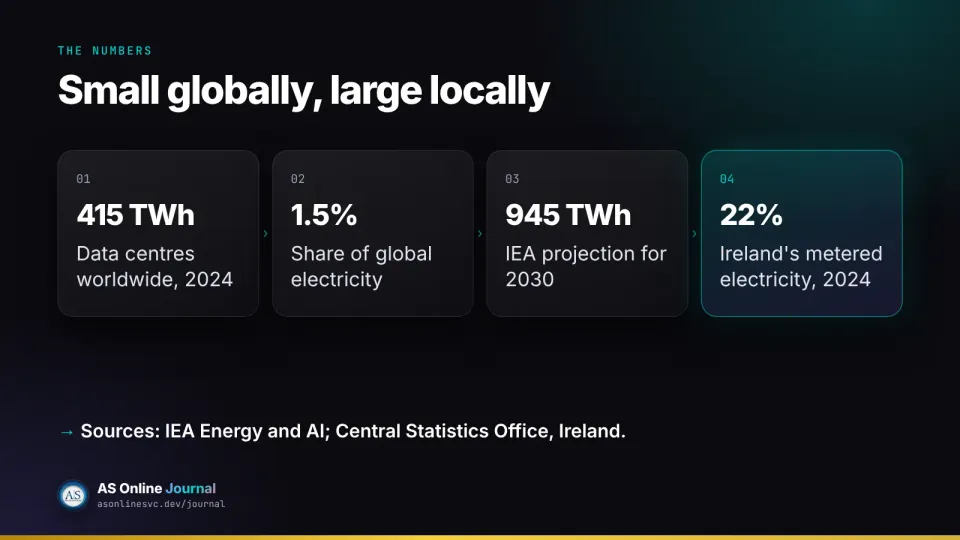
The web runs on data centres, and data centres run on electricity. Globally, the share is modest: around 1.5% of the world's electricity in 2024, according to the International Energy Agency. But demand is growing fast, driven by AI, and the effects are concentrated in a few places, where they can shape local grids, prices and planning. Who pays depends on where you live, and the honest answer includes a lot of uncertainty.
The IEA's Energy and AI report found that:
The IEA itself stresses that the global share is small but that "their local impacts are far more pronounced".
Ireland is the clearest example in Europe. Its Central Statistics Office reported that data centres used 22% of all metered electricity in 2024, up from 5% in 2015 and 21% in 2023. That is more than urban homes, at 18%.
| Who | How the cost can show up |
|---|---|
| Communities near data centre clusters | Competition for grid connections, land and sometimes water for cooling |
| Electricity bill payers | Network upgrades may be shared across all users, depending on how a country's system allocates costs |
| Clean energy goals | If demand grows faster than clean supply, more fossil generation may run for longer |
| Smaller businesses | Grid capacity taken up by large users can delay connections for others |
These effects vary widely by country and by how regulators and grid operators set the rules. Not all of them happen everywhere.
There are real arguments on both sides. Data centres can be among the most efficient ways to run computing, often more efficient than scattered servers in offices. Some operators sign long contracts for new renewable power, which can help build clean capacity. And forecasts for AI demand are uncertain, as the IEA's own range of scenarios shows. The honest position is that the total is growing, the local strain is real in some places, and the long-term balance is still being worked out.
You cannot fix grid policy from a website, but you can stop adding waste:
The W3C's Web Sustainability Guidelines collect many of these practices in one place.
One website's electricity is tiny. The web's is not, and it is growing quickly in a few places that bear most of the strain. The good news is that most of what reduces a site's energy use also makes it faster and cheaper to run. That is a rare case where doing the right thing and the practical thing are the same.
The IEA's Energy and AI report says data centres accounted for around 1.5% of the world's electricity consumption in 2024, or 415 TWh, and projects around 945 TWh by 2030, with AI as the most important driver.
In particular places. Ireland's Central Statistics Office reported that data centres used 22% of the country's metered electricity in 2024, up from 5% in 2015.
Individually the effect is small, but lighter pages, sensible caching and choosing a host that publishes its energy sources all reduce demand, and usually make sites faster too.