News & ExplainersExplained
6 min readNew

Solar sensors, lights and trackers look like free, clean power. The costs land elsewhere: in batteries, short lifespans and the people who handle the waste. What the evidence shows, and better questions to ask.
Solar-powered smart devices, from garden lights and doorbell cameras to city sensors and parcel trackers, can be genuinely useful. They avoid mains wiring and cut battery swaps. But "powered by the sun" is not the same as "free of cost". The costs move: into the battery every solar device needs, into products designed to be replaced rather than repaired, and onto the people, often far away, who deal with the waste. None of this means avoiding solar devices. It means asking better questions before buying them.
The UN's Global E-waste Monitor 2024, from ITU and UNITAR, reported that the world produced a record 62 million tonnes of electronic waste in 2022, up 82% from 2010, and is on track for 82 million tonnes by 2030. Less than a quarter, 22.3%, was documented as properly collected and recycled.
Small connected devices are a growing part of that stream. They are cheap, numerous and easy to throw away, and their batteries and circuit boards are hard to recover once they are mixed with household rubbish.
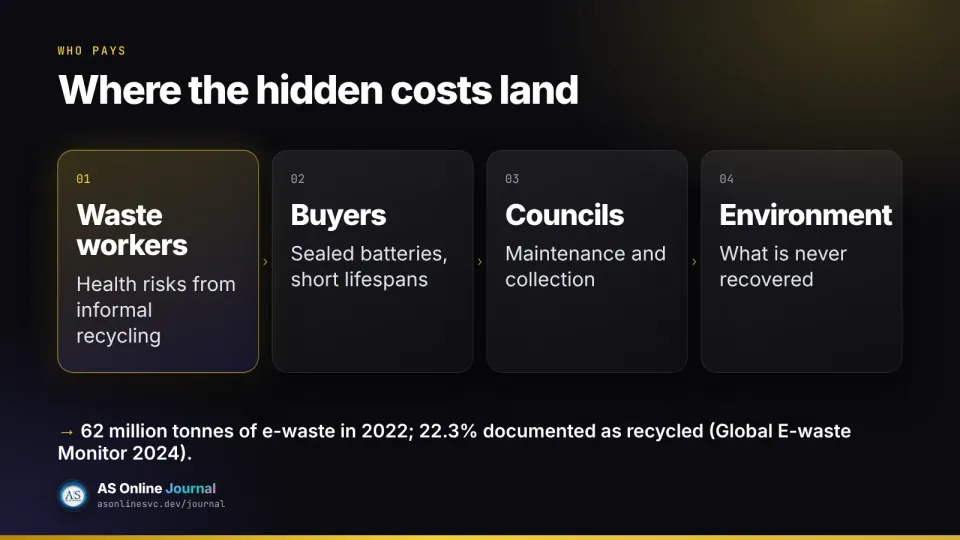
The WHO's e-waste fact sheet says informal recycling, including open burning, can release substances such as lead, and that children and pregnant women are particularly vulnerable. ILO and WHO estimate that millions of women and child labourers in the informal recycling sector may be at risk. These are rarely the people who bought the devices.
A solar device lives or dies by its battery. If the battery cannot be replaced, the whole device is waste when it wears out, even if the solar panel and electronics are fine. Connected devices also depend on software: once security updates end, a device can become unsafe to keep online. In the UK, makers of consumer connectable products must now publish a minimum security update period, which helps buyers compare.
When councils or businesses deploy hundreds of solar sensors or lights, the cost of maintenance, battery replacement and end-of-life collection lands on future budgets. A device that is cheap to install can be expensive to look after.
It is easy to tell this story too simply. Solar devices can replace disposable batteries or long cable runs, and in places without reliable mains power they can widen access to light, connectivity and safety. Whether a particular device is a net gain depends on how long it lasts, what it replaces and what happens at the end. The honest answer is that it varies, and good data on small connected devices is still limited.
| Question | Why it matters |
|---|---|
| Can the battery be replaced? | Turns a worn-out device into a cheap repair instead of waste |
| How long are security updates promised? | A connected device without updates becomes a risk |
| Does it need an app or cloud service to work? | If the service shuts, the device may stop working |
| Will the seller take it back? | UK rules on electrical waste give retailers and producers take-back duties |
| Do I need it to be connected at all? | A simple solar light with no app often lasts longer |
Solar power on a device is a real benefit. The hidden costs come from design choices: sealed batteries, short support periods and no plan for the end of life. As buyers, councils and businesses, we can reward the products that get those choices right. The people downstream who handle the waste will never see the sales page, so it is up to the rest of us to ask.
The UN's Global E-waste Monitor 2024 reported a record 62 million tonnes in 2022, of which only 22.3% was documented as properly collected and recycled. It projected 82 million tonnes by 2030.
The WHO says informal recycling, including open burning, can release substances such as lead, and that children and pregnant women are particularly vulnerable. ILO and WHO estimate millions of women and child labourers in the informal sector may be at risk.
Not necessarily. They can avoid cables, mains power and frequent battery swaps. The question is how long they last, whether their batteries can be replaced, and whether they are recycled properly at the end.