News & ExplainersExplained

5 min readNew
Security updates, honest support dates, fast breach reporting and a fair way out. What UK law already requires, where it stops, and what users can do when a company lets them down.
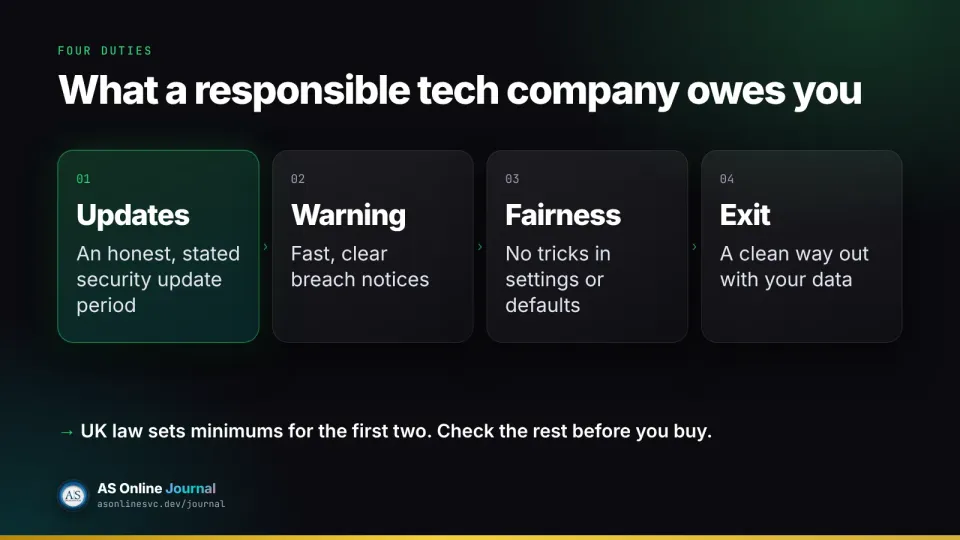
A responsible tech company owes its users four things beyond a product that works on day one: security updates for an honest, stated period; quick and clear warning if their data is exposed; settings and defaults that do not trick them; and a fair way to leave with their data. UK law now sets minimums for the first two. The rest still depends largely on the company, which is why it pays to check before you buy or sign up.
Since 29 April 2024, the UK's product security regime has applied to consumer connectable products such as smart speakers, cameras, TVs and doorbells. GOV.UK sets out three security requirements:
That third point is the one to look for when you shop. A device without updates becomes riskier every month it stays online.
Under UK GDPR, the ICO's guidance says organisations must report a notifiable personal data breach to the ICO "without undue delay, but not later than 72 hours after becoming aware of it". If the breach is likely to result in a high risk to people, they must also tell those people directly without undue delay.
| Failure | What it looks like | What a responsible company does instead |
|---|---|---|
| Silent end of support | A device or app stops getting updates, or stops working, with little notice | States the support end date up front and gives long notice of changes |
| Slow or vague breach notices | A late email saying "an incident may have affected some data" | Says what happened, what data, what it is doing, and what you should do |
| Dark patterns | Pre-ticked boxes, hard-to-find privacy settings, cancel buttons hidden away | Clear choices, privacy-friendly defaults, cancelling as easy as signing up |
| Lock-in | No way to export your photos, notes or history | A simple export in a common format |
| No route for researchers | Security flaws reported and ignored | A published reporting address and a response |
The rules above are minimums. Much of what users expect, such as long support, easy exports and fair design, is still a choice companies make. When comparing products, treat a long, clearly stated support period and an easy way to leave as features worth paying for.
A company that tells you how long it will support a product, warns you quickly when something goes wrong, and lets you leave with your data is showing respect for its users. The law now insists on some of that. The rest is worth checking for yourself, before you hand over money or data.
Yes. Under the UK's Product Security and Telecommunications Infrastructure regime, in force since 29 April 2024, makers of consumer connectable products must publish the minimum length of time security updates will be provided, with an end date.
Under UK GDPR, a notifiable breach must be reported to the ICO without undue delay and not later than 72 hours after the organisation becomes aware of it. If there is a high risk to people, they must be told directly without undue delay.
Generally yes, after its stated support period. That is why the published minimum security update period matters: check it before you buy.
consumer-rights product-security data-protection uk tech-policy