News & ExplainersExplained

6 min readNew

Contactless fares and live apps have made travel easier for most of us. The cost of that convenience lands on people who are easy to overlook, and the 2023 ticket office row showed how many care.
For most travellers, digital public transport is a genuine improvement: tap a bank card, check the next train on your phone, get a refund in an app. But each step that moves a service online also moves a little work, risk or exclusion onto someone else, usually people with the least room to absorb it. The question is not whether transport should go digital. It is whether the people who gain are quietly being subsidised by the people who lose, and whether anyone is measuring it.
It is worth starting with what has gone right. In London you can pay as you go with contactless or an Oyster card on all Transport for London services, and the system works out the fare for you. Live departure boards in your pocket mean less time waiting on cold platforms. For many disabled travellers, being able to check step-free routes or book assistance from home is a real gain in independence.
Any honest account has to hold on to that. Romanticising the ticket queue helps nobody.
The costs of going digital are rarely charged to anyone's account. They show up as effort, anxiety and missed journeys, spread across people who are not in the room when the decision is made.
The Office for National Statistics described this years ago in its analysis of the UK's digital divide: the number of people who have never used the internet has fallen, but those who remain offline tend to be older, disabled or on lower incomes. The people least able to cope with a digital-only service are the people most likely to depend on public transport.
In July 2023 train companies in England proposed closing most station ticket offices and moving staff onto concourses. The consultation that followed drew around 750,000 responses to the passenger watchdogs, according to Transport Focus. London TravelWatch said 99% of the responses it received were objections. The three big issues it heard were how to buy tickets in future, how to get travel advice at stations, and how disabled passengers would get assistance.
Both watchdogs objected, and on 31 October 2023 the government asked operators to withdraw the proposals. The Rail Delivery Group confirmed they were not being taken forward.
The interesting part is not the outcome. It is what Transport Focus said along the way: it supported the principle of moving some staff from behind glass to where passengers are, and recognised the financial pressure on the railways. Its objection was about detail. Could machines sell every ticket? Could they take cash and give refunds? Would "welcome points" actually work? In other words, the public was not rejecting technology. It was rejecting a plan that had not yet shown how the people who needed a human would still find one.
There is a serious counterargument, and it deserves to be put well. Staffed ticket offices are expensive, and in a stretched budget every pound spent there is a pound not spent on trains, maintenance or lower fares. Most journeys are already bought online or by tap. Designing a whole network around the minority who cannot use digital tools may mean worse service for the majority, including many low-income passengers who would benefit from cheaper, simpler fares.
That argument is strongest when the money saved visibly goes back into the service, and weakest when it simply disappears, along with the person who could have helped.
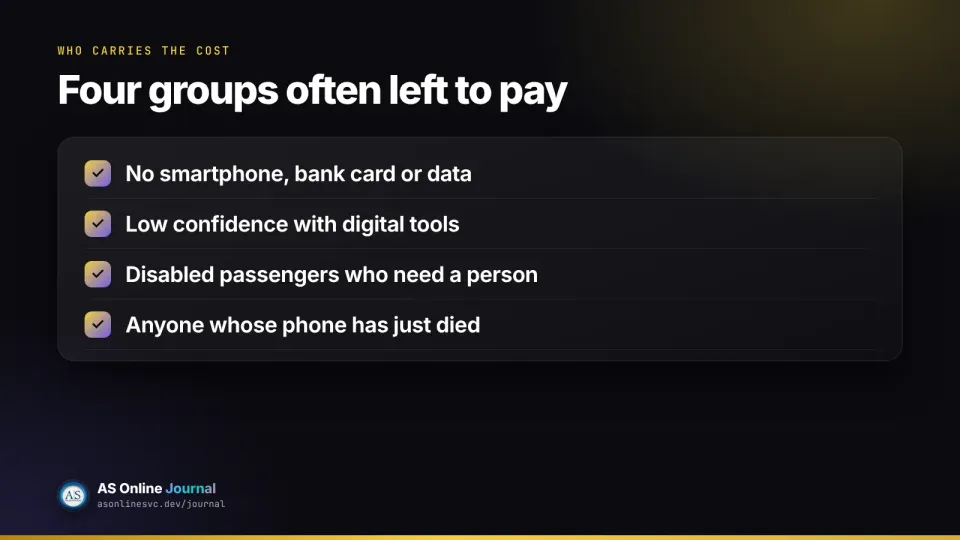
Here is a test we think any operator, council or software supplier could use. A digital change is fair if it passes all four:
Under the Equality Act 2010, service providers already have a duty to make reasonable adjustments for disabled people. The test above goes a little further, because digital exclusion is broader than disability. But the principle is the same: the cost of convenience should not be invisible, and it should not fall on the people with least power to object.
The 2023 consultation showed that hundreds of thousands of people will speak up when they can see a change coming. Most digital changes are smaller and quieter: one fare made app-only, one help point removed. The useful habit, for anyone designing these systems, is to ask each time: who does this make life easier for, and who has to work harder because of it?
No. Train operators in England proposed closing most station ticket offices in July 2023. After a consultation that drew around 750,000 responses, the passenger watchdogs objected and, on 31 October 2023, the government asked operators to withdraw the proposals.
Good Things Foundation's Digital Nation 2024 summary puts it at 8 million adults lacking basic digital skills, and 34 million online with some barriers or vulnerabilities. These are estimates from a charity's compiled research, not an official census.