
News & ExplainersNews brief

5 min readNew
On 24 November the UK's National Cyber Security Centre said it has seen a marked rise in attacks run by AI-driven frameworks since September. Here is what it said, what it did not, and a checklist for a small team.
On 24 November 2026 the UK's National Cyber Security Centre (NCSC) said that, since September, it has seen a marked rise in AI-assisted cyber attacks. Attackers are using "agentic offensive frameworks", software built for authorised red-team testing, to probe an organisation's internet-facing services and try to exploit them in quick succession. The NCSC's central point is reassuring and uncomfortable at once: none of the weaknesses being exploited are new. What has changed is speed, persistence and cost. The fixes are the familiar ones, and the deadline for doing them has moved closer.
According to the NCSC's blog post, organisations across several sectors have reported incidents. The attacks involved automated discovery and exploitation attempts against internet-facing services, in some cases causing downtime or compromise that gave attackers a foothold for further activity.
It describes a framework as software that lets an AI model use off-the-shelf security tools: the model plans a sequence of steps, runs the tools against a target, reads the results and decides what to do next. The NCSC says that, at the time of writing, this activity has become associated with a framework called ARTEX, and names others, so it focuses on the pattern rather than any one tool. Compared with a human working alone, it says an agent and framework move from discovery to exploitation in minutes, try every endpoint, parameter and credential they find, learn from failures, and are cheap to run at scale.
An independent report from CyberScoop quotes a CrowdStrike analyst describing an attack on a healthcare organisation in Argentina, in which, he said, an agent identified and exploited a SQL injection vulnerability about 90 minutes after being pointed at the target with only rudimentary instructions. That is one analyst's account, reported secondhand, and not an NCSC finding. TechCrunch reports the NCSC's message the same way: many of these attacks are preventable with basic defences.
The NCSC lists the low-hanging fruit that agentic attacks are exploiting:
It adds that once an agent has a foothold it explores the environment, relying on credentials that are over-privileged for their purpose and on networks that are flat or interconnected. Services that were successfully compromised are sometimes ones the organisation had forgotten, such as old websites and legacy equipment.
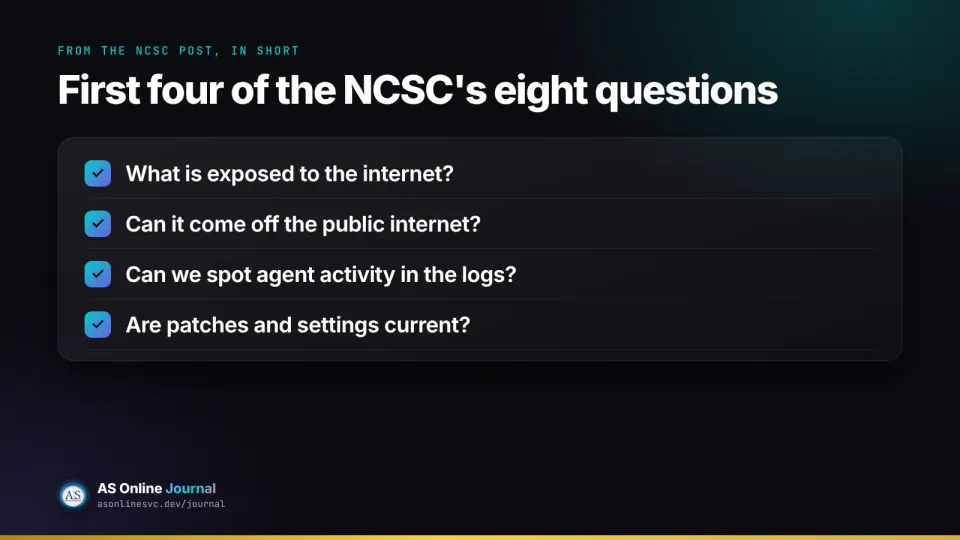
The NCSC frames its advice as questions. Here they are in short form, from the post:
For a practical start, our guides on rotating an API key safely and zero trust for small teams cover two of these areas. The NCSC also points organisations to Cyber Essentials, the Cyber Assessment Framework for essential services, and zero trust principles.
Facts in this article were checked against the sources listed below on 25 November 2026. If you think you have been compromised, the NCSC has response and recovery guidance, and UK organisations can report incidents through the NCSC's reporting service.
In a blog post on 24 November 2026, the NCSC said that since September 2026 it has seen a marked rise in AI-assisted cyber attacks, in which threat actors use agentic offensive frameworks, software designed for red teaming, to find and exploit weaknesses across an organisation's internet-facing services in quick succession.
No. The NCSC says none of the weaknesses being exploited are new or novel, and that the tools the agents use are common. What has changed is how quickly and persistently attackers can act, at low cost.
The NCSC's questions start with knowing what is exposed to the internet and who is responsible for it, then taking services off the public internet where possible, patching, checking for exposed credentials and protecting APIs. Cyber Essentials sets out minimum technical controls.