News & ExplainersNews brief

5 min readNew
Microsoft closed the access path on 19 November, but credentials taken before then still work until you change them. Here is who is affected, what was exposed and the order to fix it in.
Microsoft has warned customers that a vulnerability in Azure API Management (APIM) Classic was exploited to read secrets stored in customer instances. According to Microsoft's Azure Service Health advisory (tracking ID MZK9-GH0), which is not public but was quoted by both BleepingComputer and The Register on 23 November 2026, Microsoft identified the issue on 18 November and closed the access path on 19 November.
The important line is the one that is easy to skim past. Microsoft says the fix "does not automatically invalidate credentials that may have been accessed before the fix was deployed". The hole is closed. Anything taken through it may still work.
Norway's National Security Authority (NSM) published its own advice on 20 November and updated it on 23 November. It says an unknown actor actively went after access tokens, secrets and named values in APIM, that the energy companies Equinor and Skagerak Energi were among those hit, and that organisations in other sectors and outside Norway are affected too.
| Your setup | What the sources say |
|---|---|
| APIM Classic: Developer, Basic, Standard or Premium | Affected, according to Microsoft's statement to BleepingComputer |
| APIM Classic: Consumption | Not affected, according to Microsoft |
| Any APIM v2 tier | Not affected, according to Microsoft |
| No Azure API Management at all | Not directly affected by this flaw |
If you are a small business that bought an app or integration from an agency, you may not know what it runs on. It is worth one email to whoever hosts it, asking whether any part of it uses Azure API Management Classic.
Microsoft's advisory, as quoted by BleepingComputer, lists:
The Register reports that Microsoft linked exposure to Classic configurations that did not follow its network security guidance, or that stored secrets directly in APIM instead of referencing them from Azure Key Vault. Microsoft's named values documentation already recommends Key Vault references, and adds a point worth knowing in any incident: anyone allowed to edit policies can read any named value by referencing it in a policy.
The reach of a stolen secret is the reach of whatever it unlocks. A subscription key opens your API. A backend credential may open the service behind it, directly, without going through APIM at all.
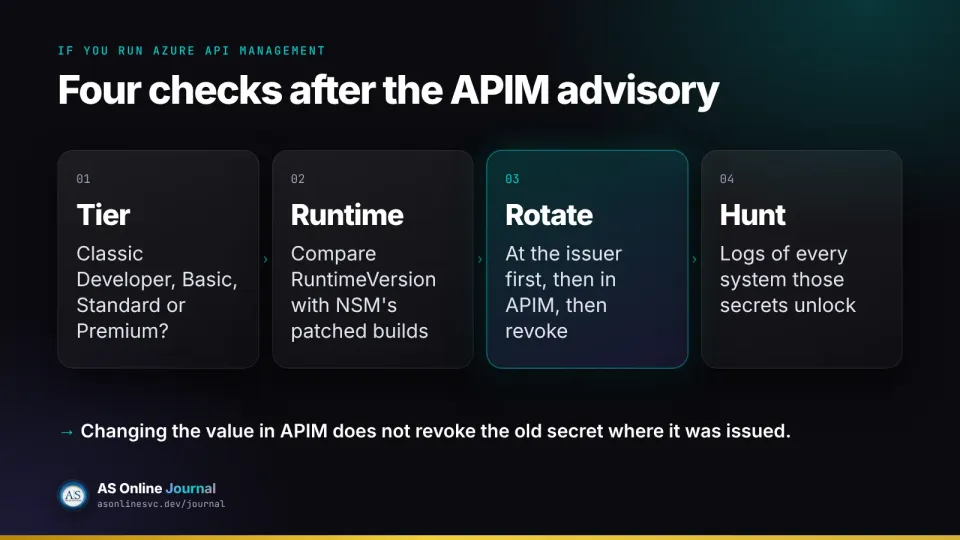
1. Find every instance. Include the development and test instances nobody has looked at in a year. Customers told The Register that forgotten instances could leave more organisations exposed. Microsoft's rotation guide, published on 21 November, includes Azure CLI and PowerShell commands to list instances across subscriptions.
2. Check the runtime version. Microsoft told BleepingComputer the fix was fully deployed to Microsoft-hosted instances and needed no customer action. NSM still advises checking. Its method: open https://<your-gateway-hostname>/internal-status-0123456789abcdef and read RuntimeVersion. A 0.52.x build is patched if the last number is 31936 or higher, and a 0.53.x build if it is 31938 or higher. NSM says other patterns belong to v2 or Consumption tiers, which are not vulnerable, and that lower numbers are still vulnerable and should be raised with the provider.
3. Rotate, at the issuer first. NSM's advice is to assume secrets and named values are exposed and to rotate all tokens and secrets. Microsoft's guide sets out the safe order: create the replacement where the credential is issued (the backend service or identity provider), update APIM, test, then revoke the old one. It also warns that changing a value inside APIM does not revoke the old credential at its issuer. The guide covers subscription keys, named values, backend credentials, OAuth and OpenID Connect client secrets, logger connection strings and credentials written straight into policies.
4. Look downstream. Map what sits behind each instance, as NSM recommends, and review sign-in and access logs on those systems from before 19 November onwards. A credential used from an unfamiliar address or at odd hours is the thing to look for.
5. Fix the habit. Move secrets to Key Vault references and use managed identities where the service supports them, as Microsoft's guide recommends. Our walkthrough on rotating an API key without an outage covers the overlap pattern and what to do in the first hour after a leak.
A gateway is where you put secrets so that applications do not have to hold them. That makes it a single, valuable target. This incident does not mean gateways are a bad idea. It means the secrets inside them need the same rotation plan as any other, written down before you need it.
Facts in this article were checked against the sources listed below on 24 November 2026. If you run affected services in the UK and suspect compromise, the NCSC incident reporting service is the place to start.
If you run an Azure API Management Classic instance on the Developer, Basic, Standard or Premium tier, yes. Microsoft has said its 19 November 2026 fix does not invalidate credentials that may have been accessed before it was deployed, so secrets stored in or used by the instance need rotating, and the systems they unlock need checking.
Microsoft told BleepingComputer that the Consumption tier of API Management Classic and all v2 tiers were not affected. Norway's NSM also says runtime versions that follow the v2 or Consumption pattern are not vulnerable.
No. Microsoft's own rotation guide says updating a value in API Management does not revoke the old credential at its issuer. Create the replacement at the issuer, update API Management, test, and then revoke the old credential.
azure api-security secrets-management incident-response news