GuidesPractical guide

5 min readNew

Pick one limit, share it out person by person, price every gift before Black Friday, and let a spreadsheet keep the running total.
Decide one number for the whole of Christmas first, then share it out: a budget for each person you buy for, and a budget for food, decorations, cards, wrapping and travel. Give every gift a planned price before the sales start, and record what you actually pay. The figure to watch is not what you have spent so far, but what you will have left once the gifts you still plan to buy are paid for.
Most of us do have a rough Christmas budget. The trouble is that it lives in our heads, split across presents, the food shop, a train ticket home and a Black Friday "deal" or two, and nobody adds it up until January.
You are not alone in wanting to keep it tighter. In a Nationwide survey of 2,000 people carried out by Censuswide on 9–12 October 2026, 36% said they expect their gift spending to be lower than last year, and 14% said they are worried about being able to afford Christmas. The most common plan to manage it was to set a strict Christmas budget (26%), followed by using loyalty points or rewards (24%) and spreading purchases across several months (20%).
A strict budget only works if you can see it, so the method below keeps everything on one page of numbers, on paper or in a blank spreadsheet.
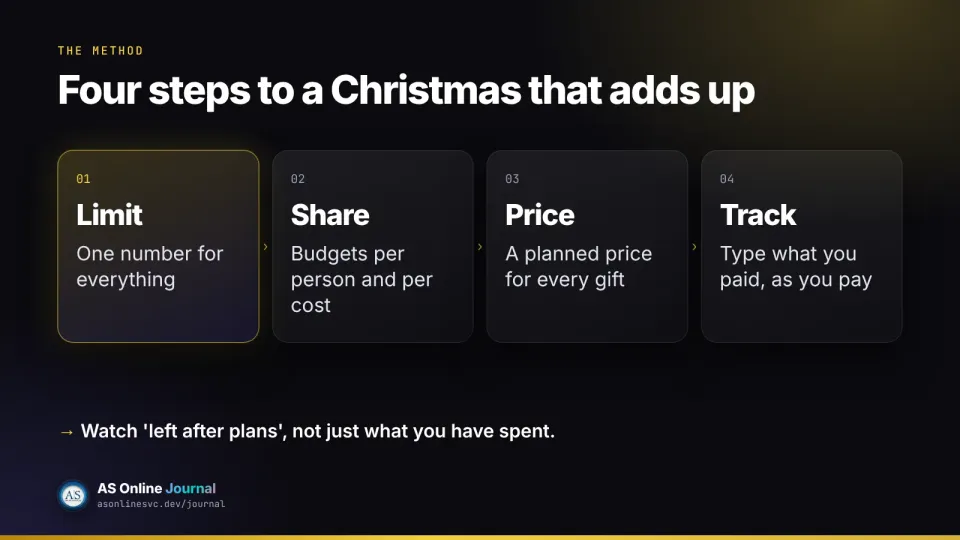
Pick the most you want Christmas to cost in total, including the things that are not presents. Base it on money you have or will have by the time you pay, not on what you spent last year. If you would need to borrow to reach it, the number is too high.
Split the limit into two lists:
Add the two lists up. If the budgets come to more than your limit, change them now, while it is only numbers. It is much easier to give a cousin £15 instead of £20 on paper than at the till.
For each person, write down your gift ideas, where you might buy them and a planned price. You do not need to know the exact gift yet. An idea with a price is enough, because the sum of planned prices for gifts you have not bought tells you what is still to come.
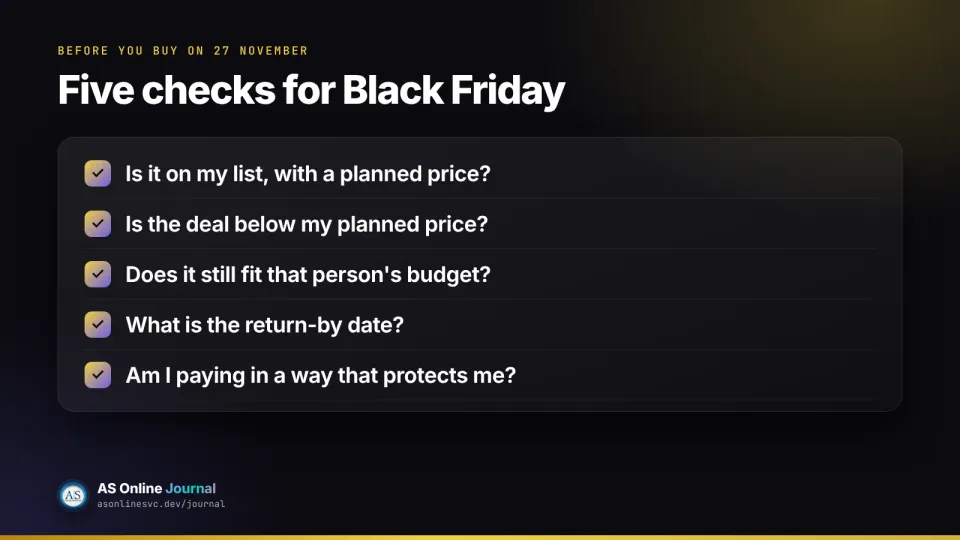
This is also your defence against Black Friday. A deal is only a deal if it is something already on your list, at less than you planned to pay.
When you buy something, note the real price and the date, and mark it as bought. For anything you can return, note the return-by date as well. For the other costs, keep a short spending log: date, category, what it was, and the amount.
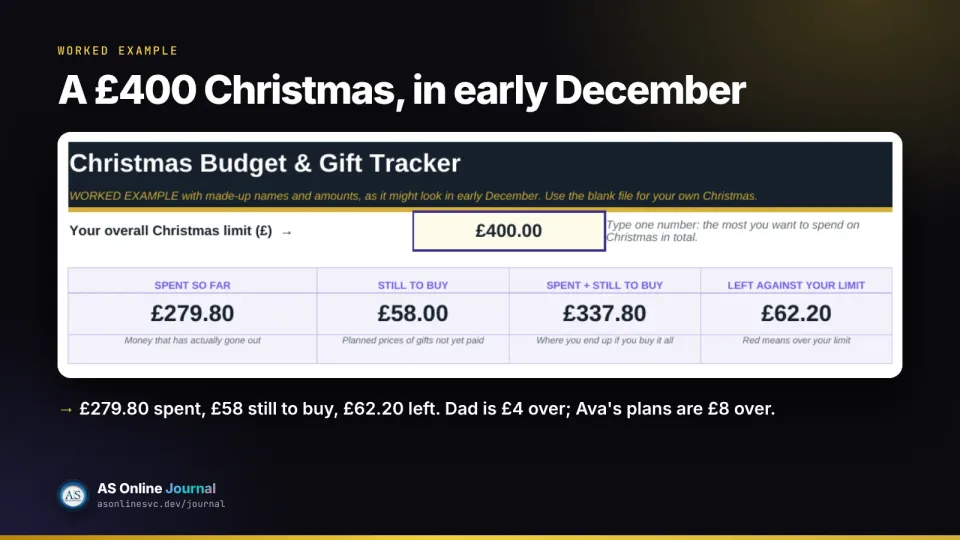
Then keep four numbers in view:
Here is a made-up household in early December. The limit is £400.
| Budget | Amount |
|---|---|
| Gifts: Mum £60, Dad £50, Sam £30, Priya £20, Ava £25, office Secret Santa £10 | £195 |
| Other costs: food £120, travel £40, decorations £15, cards £15, wrapping £10 | £200 |
| All budgets | £395 |
The budgets come to £395, so there is £5 of breathing space before anything is bought. A few weeks in, the totals look like this:
| Amount | |
|---|---|
| Gifts paid for | £134.00 |
| Other costs paid for | £145.80 |
| Spent so far | £279.80 |
| Still to buy (planned prices) | £58.00 |
| Spent plus still to buy | £337.80 |
| Left against the £400 limit | £62.20 |
Overall, this Christmas is on track: 84% of the limit is spent or planned. But the detail matters. Dad's present came to £54 against a £50 budget, so he is £4 over. Ava's two gifts are not bought yet, but their planned prices add up to £33, which is £8 more than her £25 budget. Travel is £6 over too.
None of that is a disaster, and that is the point. Spotted in early December, an £8 overspend is a change of plan (a cheaper stocking filler, or £8 from the £62.20 left). Spotted on Boxing Day, it is just part of a bigger bill.
Black Friday is on Friday 27 November this year and Cyber Monday is on 30 November. You do not have to take part: in the same Nationwide survey, 42% said they do not plan to buy anything in the Black Friday or Cyber Monday sales, and only 13% said they buy most of their Christmas presents in that period.
If you do shop the sales, these habits keep them inside your plan:
If you are posting presents, Royal Mail's recommended last posting dates for Christmas 2026, as listed when we checked on 23 November 2026, include:
| Service or destination | Last recommended posting date |
|---|---|
| 2nd Class | Friday 18 December |
| Tracked 48 | Saturday 19 December |
| 1st Class and Tracked 24 | Monday 21 December |
| Special Delivery Guaranteed | Wednesday 23 December |
| Europe (most countries) | Friday 11 December |
| Belgium, France, Germany, Ireland, Netherlands, Spain, Switzerland | Tuesday 15 December |
| USA and Canada | Saturday 12 December |
Royal Mail lists more countries and says the dates are subject to change, so check its page before you post, and put postage in your "cards" or "other costs" budget.
A tracker helps you share out money you have. It cannot make a limit that is too tight work, and it is not financial advice. If Christmas means borrowing you are worried about, or you are already behind on bills, free and impartial help is available from MoneyHelper and Citizens Advice before you spend, not after.
Free first: the four steps above work on paper or in a blank spreadsheet. MoneyHelper, the free government-backed money guidance service, also has a free budget planner for your wider household budget. The product below is only for people who would rather not build the Christmas sheet themselves.
This article is paired with our own product, the Christmas Budget & Gift Tracker, at £5. It is not a third-party offer, and AS Online earns the sale price if you buy it.
It is a spreadsheet for Excel, Google Sheets and LibreOffice: set one limit, give everyone a budget, and a dashboard shows what you have spent, what is still to buy and what is left, with checks that flag an overspend, a missing budget or a return date coming up. It comes with the worked example above as a separate file, a printable gift list and a quick-start guide. It is a budgeting aid, not financial advice.
There is no right figure. Start from what you can afford without borrowing, set that as one overall limit, and share it out. Nationwide's October 2026 survey found people expect to spend an average of £103 on each of their closest loved ones, but that is an average, not a target.
Usually, if you bought it online from a business. Citizens Advice says you normally have 14 days to cancel, starting the day after delivery, with exceptions such as personalised or perishable items. For things bought in a shop, change-of-mind returns depend on the shop's own policy, so check it and note the return-by date.
MoneyHelper explains that paying by credit card for a single item costing more than £100 and up to £30,000 can give you Section 75 protection, and that debit card payments may be covered by chargeback. Only use a credit card if you can clear the balance, and see MoneyHelper for the details.
Yes. The product's spreadsheet uses only functions that exist in both Excel and Google Sheets, and its quick-start explains how to open it in Sheets with UK date and currency settings.