News & ExplainersExplained

6 min readNew

Testing with the people most likely to be left out takes more time, money and care. When teams skip it, the cost moves to the users. What good practice looks like, and who carries the load either way.
Inclusive user research means deliberately testing products with people who are easy to leave out: disabled people, older people, people with low digital confidence, people on poor connections, and people who speak English as a second language. It costs more than testing with colleagues or regular volunteers. When teams skip it, the cost does not disappear. It moves onto the users who later find the service hard or impossible to use. When teams do it, a surprising share of the cost can still fall on participants and the charities who help recruit them.
The GOV.UK Service Manual, one of the most widely used public guides to user research, is frank about what is involved:
All of this takes longer to arrange and costs more per session than a quick test in the office.
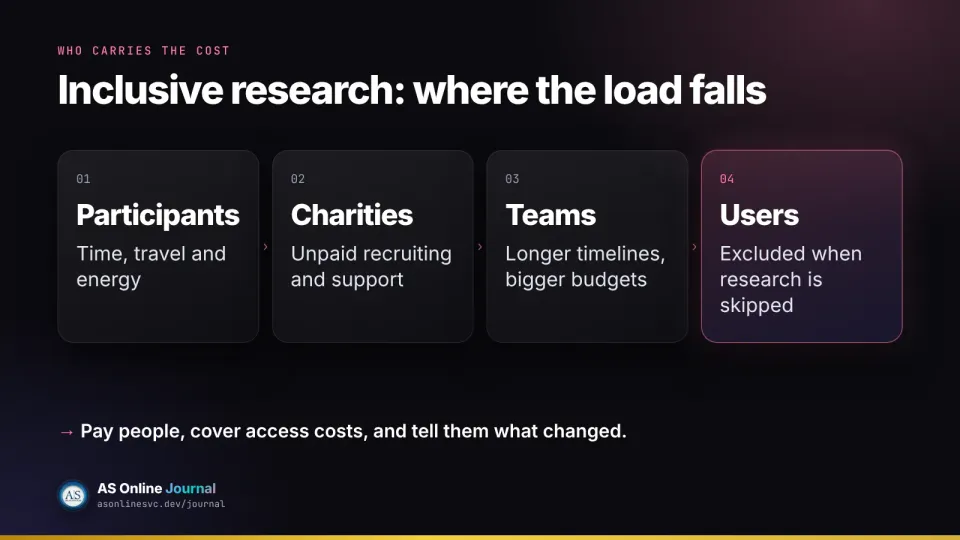
| Who | The hidden cost |
|---|---|
| Participants | Time, travel, energy and sometimes the stress of being tested on something that does not work for them |
| Charities and support groups | Unpaid time spent finding and supporting participants, often for many organisations at once |
| Researchers and teams | Longer timelines and bigger budgets that must be argued for |
| Users, when it is skipped | Services that exclude them, workarounds, phone queues, or giving up |
The last row is the largest and least visible. In 2018, the Office for National Statistics estimated that 5.3 million UK adults, about 10% of the adult population, had never used the internet or had not used it in the previous three months. Figures have changed since, but the point stands: a service designed only around confident users leaves a lot of people out.
There is a quieter problem too. Disabled people and members of small communities are often asked to take part in research again and again, by many organisations. GOV.UK's guidance warns against overusing the same participants, noting that "it is not fair to use too much of their time for research, especially if it's not their day job". Inclusion done badly can become extraction: the same few people giving their time so that others can say they consulted.
There is no agreed standard for how much to pay participants or partner organisations, and views differ on whether payment can affect what people say. Small teams and charities often cannot afford agency rates. The honest answer is that inclusive research is a trade-off between budget, speed and who bears the cost, and teams should make that trade-off openly rather than by default.
Inclusive research is more expensive per session. Not doing it is more expensive overall, but that cost lands on the people with the least power to complain. Budget for it, pay people properly, and treat participants' time as the valuable thing it is.
The GOV.UK Service Manual says it is normal for members of the public to get an incentive in return for their time, and that you should also consider compensating organisations that help you find participants.
GOV.UK's guidance notes you may need to pay extra expenses, such as a helper, taxis, or a sign language interpreter. It also advises asking participants to bring their own assistive technology, or visiting them if they cannot.
Because your results will reflect only those people. GOV.UK warns that it is hard to recruit an unbiased sample, and that when, where and how you recruit can include some people and exclude others.